
Out of the Box
Revelations and Conversations from the Archive of Rabbi Lord Jonathan Sacks
by Rachel Misrati[1]
Introduction
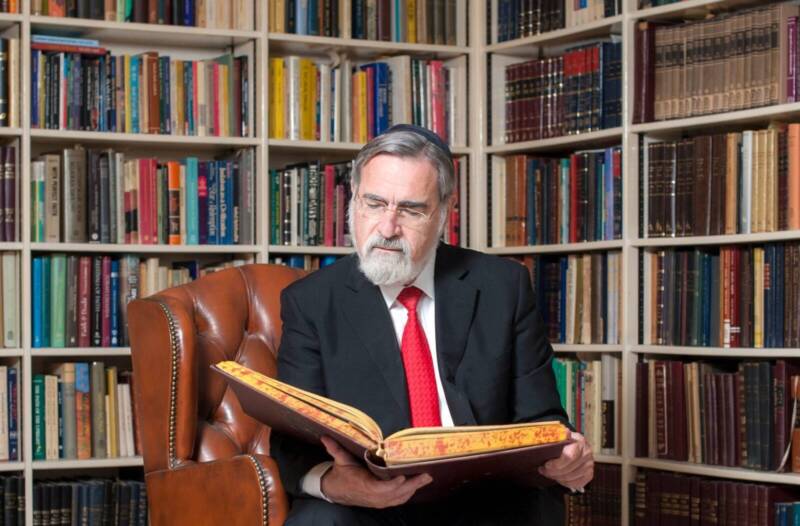
Rabbi Sacks was a master of the written and spoken word. During his lifetime he wrote 40 books and hundreds of articles for the press and academic forums. He spoke to Jewish communities around the world, to interfaith gatherings and to academic audiences, and he broadcast on radio and television, reaching wide national and international audiences. The evidence is there in print, sound-bites and film. This is the public face of Rabbi Sacks, the finished, polished product that was accessible to all.
In April 2024 Rabbi Sacks’ personal archive arrived at the National Library of Israel. The archive contains handwritten notes or typed texts of sermons, lectures, talks, articles, book drafts and plans, regular media columns or broadcasts, personal thoughts, awards, posters, correspondence, material collected by him for his research, photographs and more. As with all personal archives, Rabbi Sacks' archive documents its creator's activity during his lifetime, activities that culminated in the polished, final product.
This article will show how the archive presents us with Rabbi Sacks’ life in context, enabling us not only to become familiar with his activities but also to understand how and why he developed and implemented the messages he wished to deliver. Through highlighting choice aspects of Rabbi Sacks' work and activities in the unique way that only an archive can offer, the article will offer the possibility of encountering the story behind the scenes, using primary sources to discover the personal input, thought process and work methods of the archive's creator, getting a glimpse of the public and personal networks and relations through his widespread correspondence and learning about his influence and persona as perceived both by private individuals and by national and international public figures.
The article will briefly touch on some of the deliberations and challenges that arose during the arrangement and recording of this personal archive.
Rabbi Sacks
Rabbi Sacks was a great believer in engaging in conversation. He called Judaism “the voice of hope in the conversation of humankind”[2], advocating for a Judaism that was unafraid to engage with the intellectual, ethical, political and personal challenges of our time. The series of books about the weekly portion written by Rabbi Sacks is called "Covenant and Conversation" or in Hebrew שיג ושיח. The title of this article is not coincidental. Rabbi Sacks believed in conversation: whether with the Torah text, the Jewish or non-Jewish past, with Jews or with non-Jews. Influenced in part by Viktor Frankel, Rabbi Sacks believed in the importance of finding meaning in life and he believed that conversation was a way to find meaning.
In 2015, in a conversation with Prof. Miroslav Volf, Professor of Theology and Director of the Yale Center for Faith and Culture[3], Rabbi Sacks explained that he believed that in Judaism, a life worth living was a life suffused with meaning. For him, in the same way that letters need to join together to make words and words join together to make a story in order to express meaning, every individual Jew represented an important element in ‘meaning’ in Judaism, but each individual needed to join others to make a family, each family needed to unite with others to make a community, each community had to combine with others to make a people, and that people had to connect with all previous generations to continue the story. "To be a Jew" wrote Rabbi Sacks, "is to keep faith with the past by building a Jewish future."[4]
From London to Jerusalem
In July 2023 Matan Barzilai, the head of archives and collections at the National Library of Israel, and I were invited by the Rabbi Sacks Legacy Trust to the London School of Jewish Studies to have a look at the archive of the late Rabbi Lord Jonathan Sacks in situ. The aim of the trip was to get an idea of the archive’s contents and to start building a structure for its arrangement and recording.
While the deposit contract was signed in January 2024, flights were few and far between because of the Swords of Iron War. Archives, even that of Rabbi Sacks, were not top priority for Israel’s national carrier, which was the only airline operating at the time. Eventually the crates arrived at the library in April, the boxes were unpacked, fumigated and then transferred to the archives department. Thirty standard archival boxes arrived, which after being arranged and put into files became over forty-five!
The material in the Rabbi Sacks archive at the National Library originates from his study (mainly hanging files) and his office (mainly box files). Official material from the Chief Rabbinate period is in the London Archives, which is the official repository for material from the Office of the Chief Rabbi[5]. His personal archive is still with the family.
To understand the full scope of the archive in the National Library, here is an abridged biography of Rabbi Sacks:
Lord Jonathan Sacks was a global religious leader philosopher and moral voice for our time. A graduate of Cambridge (BA/MA) and Oxford Universities and Kings College London (PhD), he received semikhah from the LSJS and London’s Etz Chaim Yeshiva. Rabbi Sacks had been a community Rabbi at various congregations in London before being appointed Chief Rabbi of the United Hebrew Congregations of Great Britain and the Commonwealth in 1991. During this time, he began his passionate advocacy for Jewish schools and Jewish education. Following his retirement from the Chief Rabbinate in 2013, Rabbi Sacks served as professor of Jewish thought at Yeshiva University, professor of Judaic thought at New York University and professor of Law, Ethics and Bible at King's College London. He was invited to give lectures and talks at prestigious academic institutions and venues around the world.
Rabbi Sacks held 21 honorary degrees and authored over 40 books. In 2005 he was knighted by Her Majesty the Queen and made a life peer, taking his seat in the House of Lords in October 2009. Described by the Prince of Wales as a “light unto this nation” and by former Prime Minister Tony Blair as an “intellectual giant”, Rabbi Sacks was a frequent contributor to radio, television and the printed and digital press, both in Britain and around the world.
He was a renaissance man who loved music, art and everything cultural, but without letting it detract or be in conflict with Torah and the Jewish way of life.
Arranging the archive
In his iconic article “Personal Archives: Arrangement and Recording”[6] Prof. Paul Alsberg, presents guidelines for dealing with a personal archive which, unlike an administrative or organizational archive more often than not lacks an orderly, organic structure. He emphasizes the importance of preserving the two aspects of provenance: the original fonds as a separate unit and the original order of the material, and suggests guidelines to arrange the personal archive while attempting to reflect as far as possible the original order of the documents as they were preserved.
Masha Zolotarevsky-Bear and Galia Duvidzon’s article “Personal Papers: The Return of the Original Order” challenge the value of this quest for a return to original order, with questions such as how can we tell if the creator did not change the order of the documents at a later stage or if the order was changed by his heir or others afterwards? Was the material only in the creator’s hands or did it pass through other custodians? Or was the material re-organised later for other reasons [such as publication]?[7] These questions are pertinent to the arrangement of the Rabbi Sacks archive in the National Library of Israel since it is known that the material we saw at the LSJS had been looked at by others after it had been deposited there. It was during our visit that we understood the importance of keeping the original order of the archive as far as it was possible, while following Alsberg’s guidelines to make retrieval of the material as efficient as possible.
At the beginning stages it was decided to arrange the archive according to the different areas of activity that Rabbi Sacks was involved with, as follows:
- Sub-Fonds 01: Sermons and Shiurim, and Talks for Jewish
- Holidays by Rabbi Sacks
- Sub-Fonds 02: Lectures, Talks, Speeches and Articles by
- Rabbi Sacks
- Sub-Fonds 03: Community Activities (Anglo-Jewry)
- Sub-Fonds 04: Writings and Publications
- Sub-Fonds 05: Personal documents
- Sub-Fonds 06: Correspondence
Activities were usually documented in specific ways, for instance, visits to communities on Sabbaths and Jewish Holidays were documented by sermons, visits to universities or academic institutions were documented by lectures, and interaction with the public or professional entities was documented by correspondence. While some of the archive was organized this way, during the arrangement of the material it became apparent that some files did not match file names that were in Rabbi Sacks’ handwriting, and some were divided and named by subject even though they contained material of various types. If such files looked original, they were kept intact and recorded as such.[8] Some files had to be physically divided up because of the volume of material in them and notes about the original order were added to the relevant file description. Sometimes copies of the same lectures appeared in two different files belonging to two different series. This reflects how copies of the lectures were filed in different places in different contexts in real life.[9]
In more than a few cases files could have logically belonged to more than one sub-fonds or series and it was necessary to decide the file's primary focus in order to arrange it in the most relevant location. For example, a file titled "Israel 2015" contained material relating to two awards received by Rabbi Sacks that year in Israel – the Unity Prize and the Rambam Award. I decided to place this file in sub-fonds 05, with the other award-related files rather than in the series containing records of engagements abroad, located in sub-fonds 02.
Joanna Benarroch, former head of Rabbi Sacks’ office and presently President of the Rabbi Sacks Legacy, was and is my urim and tumim for any questions I had regarding the archive. She has provided me with context, background details and stories which have helped me make decisions while arranging the archive. A recent example of this is an undated talk given by Rabbi Sacks in Madrid that I was cataloguing. I searched for information about Rabbi Sacks in Madrid on the internet, with no success, and Google's Gemini authoritatively told me that he had never been in Madrid. Just to be sure I checked in with Joanna, who assured me that he spoke in Madrid in 2013. I broke the bad news that AI said he was never in Madrid to which she replied: "I was with him. We were there!!!"
Visitors to the archive who worked or were in contact with him also filled me in on details, stories and context and later in the article I will show how they provided an interesting and additional angle on the archive.
The second half of Zolotarevsky-Bear and Duvidzon’s article focuses on whether the born-digital archive or records created in the digital environment automatically include meta-data that documents the records’ original order. Rabbi Sacks’ archive does not include born digital material, other than printed emails and downloads from the internet, so these are questions that may need to be considered if such material is added to the archive in the future.
Rabbi Sacks’ archive is now almost entirely listed in the National Library of Israel’s online catalogue and at least half of it has already been digitized.
My familiarity with the archive
On a personal note, working on a personal archive means that you sometimes find yourself on the same wavelength as the archive's creator. Rabbi Sacks was such an expert speaker that it is hard to believe that most of his speeches in the archive are just notes. I often wondered how he managed to give such polished speeches just from notes, without having the full text in front of him. How one word on a line was enough to remind him of what to say. But, having gone through thirty boxes of his archive, I can say that I have become familiar with his style and his trigger words. For instance, when I see the words Arsenal/Man United in notes for a speech, I know he is referring to the following anecdote that he would use in his interfaith work:
"Way back in 1990, when I'd been chosen and not yet appointed as Chief Rabbi and George Carey had been chosen, but not yet taken up office as Archbishop of Canterbury, somebody discovered that we shared a passion…Somebody discovered that we supported the same soccer team, a team called Arsenal…So they said, "How would you like your first ecumenical gathering to be in our box in Highbury Stadium watching Arsenal play a midweek match for obvious religious reasons?"
So it happened, the Archbishop said yes, I said yes, and it was amazing… We were taken down to meet the players. We were taken out onto the holy ground of the turf itself and presented a check to charity.
The public address system announced that Arsenal had with them tonight the Archbishop of Canterbury and the Chief Rabbi and you could hear the buzz go around the crowd...that night Arsenal had friends in high places, they could not possibly lose.
That night, and this is a matter of record, you can look it up, Arsenal went down to their worst home defeat in 63 years. They lost 6-2 at home to Manchester United. The next day, an English paper, newspaper or national, carried the story and commented as follows, verbatim. They wrote, "If the Archbishop of Canterbury and the Chief Rabbi between them cannot bring about a win for Arsenal, does this not finally prove that God does not exist?"
The next day they printed my reply, which was very simple. I said, "To the contrary, it proves that God exists. It's just that He supports Manchester United."[10]
Rabbi Sacks and the National Library
Rabbi Sacks had a close relationship with the National Library. Both as an academic and as a Rabbi who believed in the importance of the written word and its links to the past, present and future of the Jewish people, the National Library of Israel was of special importance to him. He was invited to spend a few days at the Library in November 2013, a short while after his retirement from the Chief Rabbinate. The fruits of this visit were recorded in his report entitled “The New Israel National Library: A Vision”. The archive holds both the final typed version of the document[11] and some of the pages of his preparatory notes.[12] Rabbi Sacks coined the phrase the ‘Home of the Book for the People of the Book’. This was the title of the speech he made at the National Library, while it was still in the Givat Ram campus in 2014.[13] During that visit I was privileged to have lunch with him together with a small group of my colleagues. Little did I imagine that 10 years later I would be working on his archive.
Since the nineteenth century, Jews have been concerned with highlighting the unique contribution that they have made to society in general, in order to justify their emancipation within civil society. The National Library’s Schwadron Autograph collection, the purpose of which was to highlight Jewish genius in all fields of life, is an outstanding example of this mindset. Such excellence often came at the expense of their Judaism and Jewish identity. This dissonance was of great concern to Rabbi Sacks as he contemplated the future of Judaism in the modern world. It can be seen as the motivation for his advocacy for Jewish education and his call for Jews to practise a strong Judaism that could encounter the outside world with confidence. Rabbi Sacks was a member of the National Library Forum. In the handwritten notes for his address to the forum in 2016 the phrase “Jews overachieved modern world. Judaism underachieved” appears at the foot of the first page of his notes.[14] This succinct comment sums up his understanding of this dissonance in world Jewry, and particularly within Anglo-Jewry, and it seems significant that he chose the National Library Forum to highlight this point.
People who influenced Rabbi Sacks
Much can be learned about a person by understanding the people who influenced them. Rabbi Sacks’ archive provides us with information about such people in different ways. The importance of the Lubavitcher Rebbe in Rabbi Sacks' career is well known. Rabbi Sacks talked about it on many occasions. The archive contains the letter that Rabbi Sacks sent to the Rebbe, after being offered the post of Chief Rabbi. Asking for advice about taking up the offer, Rabbi Sacks wrote: “Should I take the job?” The Rebbe replied by using the proof-reading sign for changing word order – “Should I” became “I should”.[15]
Articles in the archive collected by Rabbi Sacks, most of which have highlighted passages and comments in the margins, bear witness to philosophers, scholars, Rabbis and other religious figures and journalists, whose work he read and whose ideas stimulated him. The philosopher Alistair MacIntyre and the journalist David Brooks are two such figures. Series 04 04 in the archive contains writings and publications by different authors collected by Rabbi Sacks, and files 74-81 contain files of material he downloaded from the internet between 2013-2019.
Personal reflection
In addition to files containing articles about Rabbi Sacks and personal interviews that he gave, the notes and comments expressing his personal thoughts and reflection provide a source of information, which is almost uniquely found in a personal archive. Rabbi Sacks made a point of learning from the past to plan for the future. His archive offers us the opportunity of reading his goals, both personal and professional at different stages of his career. Lists of tasks sometimes appeared at the end of speech notes, showing how he began by focusing on a specific subject and then broadened his field of thought. Often, he lists practical solutions to achieving these goals. An example of planned professional goals is a page of handwritten notes in one of the files with the title Future Tense. “1. Go through past lectures…don’t reinvent the wheel…2. Do pamphlets first. Don’t worry about the book…3. Set a writing timetable…” And on the same page: TO DO: Future Tense, Covenant and Conversation, Listening…Conflict Resolution, Jewish Leadership…Pirkei Avot, Prince Hassan…The Dummy’s Guide to Happiness…[16]
One such document from 2013 contains Rabbi Sacks’ personal reflections on his years in the chief rabbinate and how he is ready to move on. The notes include inspiring phrases that characterize his approach to life, such as “failures/errors - supreme learning experience” and "outside comfort zone: acquire new skill", "22 years hungrier more energetic now than then".[17]
Rabbi Sacks and Britain
Rabbi Sacks was quintessentially British and proud of it. He wrote more than once about how grateful he was that his father found refuge in Britain and about how much he himself admired Britain and benefitted from being British. A lovely illustration of this is a piece he wrote, probably for his Credo column in The Times, entitled "British Values". His tone is characterized by his gentle, tongue-in-cheek humour:
"To me Britain is the birthplace of freedom in the modern world, the land of liberty, the home of Shakespeare, the greatest writer who ever lived…I loved and still love its eccentricities. Could any other country have invented cricket, a game teams can play for five days without achieving a result? ... Britain never produced a literature of hate. And how can you fail to love a country where the weather can bring you all four seasons in a single day?"[18]
Rabbi Sacks’ special relationship and contribution to British society was officially recognized in 2005 when he received a knighthood from the Queen. In 2009 Rabbi Sacks was made a life peer and the archive contains the schedule for the day he delivered his maiden speech in the House of Lords in 2009, the text of his speech and some of the congratulatory letters he received from both friends and from colleagues already sitting in the House of Lords.[19] “The Knight in a Black Velvet Kippa” is the title of an article about Rabbi Sacks’ book Dignity of Difference that can be found in the archive.[20] To my mind this image reflects the successful way in which Rabbi Sacks carried both his Jewish and his British identities.
While series 02 in sub-fonds 03 focuses on the Chief Rabbi’s involvement with Anglo-Jewish organisations, sub-fonds 05 focuses on the Chief Rabbi’s visits to various communities in the United Kingdom. In both series, whether he was marking important anniversaries of synagogues and communities around the country, being a guest at a shabbaton or presiding at the induction of a new Rabbi, the archive bears witness to how Rabbi Sacks sought to cultivate within Anglo-Jewry the conversation between the Jewish past and future and between Judaism and the outside world. Also included are his speech notes relating to the UK’s small communities. Files of these speech notes provide us with what is probably the only existing record of those speeches. In a similar vein, sub-fonds 01, which comprises mainly notes he used when giving sermons on Sabbaths and Jewish Holidays, provide us with evidence of these addresses, which would otherwise have been lost due to the religious prohibition of recording on those holy days.
During his term of office as Chief Rabbi, Rabbi Sacks composed prayers for different occasions, ranging from a prayer on the tenth anniversary of the conflict in Rwanda to prayers for the end of Covid.[21] Rabbi Sacks was especially conscious of his duty as the representative of Britain’s Jewish community to express the community’s sentiments on the occasion of major events in the country. The archive contains the handwritten version of the prayer that he wrote on the death of the Queen Mother in 2002 and the subsequent typed version that he faxed to the Chief Rabbi’s Office so that it could be distributed to United Synagogue communities across the country.[22]
Rabbi Sacks in the British media
Rabbi Sacks used his position as leader of the British Jewish community to pursue his aim of presenting Judaism as a vibrant religion, able to encounter the world and take its meaningful place in society. To this end he realized the potential platform of media, and later social media, and was active in his outreach not only to the Jewish community but to the public at large. His success at being recognised by the government, church, other religious communities and media as spokesman for the Jewish community, as well as being seen as one of the leading moral and spiritual voices in contemporary society, was due to a great extent to his personal contributions to the national press, radio and television.[23] For instance, material in the archive documents him speaking out on moral social issues, such as child poverty and against the Assisted Dying Bill in 2003.[24]
The archive contains the typed versions he sent to the BBC of his ‘Thought for the Day’ broadcasts on Radio 4 and versions of his Credo columns that he sent to The Times. There are also final drafts of other media articles he contributed to newspapers such as The Times, the Daily Telegraph, the Jewish Chronicle and the Jewish News. Rabbi Sacks made special broadcasts to the nation for Rosh Hashanah and some of their scripts have also been catalogued.
Correspondence in the archive directly connected to his media appearances show how highly respected he was. In a letter from 1997, Ernest Rea, head of religious broadcasting at the BBC, hopes that the Chief Rabbi will continue his “most important task to provide leadership to the entire nation” and ensure the future of “your own people” in England.[25]
We learn from the archive how his broadcasts reached people from all walks of life. For instance, there is an email dated September 2001 from a lady in Plymouth. She writes that she often saved his quotations to share and discuss with her adult children. Her family is Roman Catholic but it does not stop her from thinking that he is “easily the most well-informed and enlightened Religious Leader in this country.”[26]
Rabbi Sacks himself was always in conversation with the past and sometimes, quite startlingly I would suggest, in conversation with the future. Of all the articles I have seen in the archive, the one that resonated with me the most was the one he wrote for the Jewish Chronicle in 1998 – "The Courage to Rejoice." It was about celebrating Simchat Torah because of the festival’s importance and despite the tragedy of Jewish history.
“To me it is the single most eloquent testimony to the spirit that kept Jewry alive in the Diaspora for more than eighteen hundred years.”[27]
In light of the events of October 7, 2023 and Simchat Torah 2025, it is a little chilling.
Correspondence with the highest in the land
I didn't expect to find much correspondence in the archive because the personal material was kept by the family and the chief rabbinate material is deposited in the London Archives. However, I was very pleasantly surprised to find at least 3 archival boxes-worth of written correspondence. Among the correspondence, bearing witness to the fact that in his role as Chief Rabbi, Rabbi Sacks was a valued adviser to Prime Ministers and Kings, there are semi-official and personal letters from British Prime Ministers such as Tony Blair[28] and David Cameron[29], thanking him for advice he gave them in their official roles. There are also some personal letters from Prince Charles (as he then was), one of which expresses HRH’s thanks for the Chief Rabbi’s congratulations on his engagement to the future Queen Camilla.[30]
Identifying correspondents was not always easy. One of the letters had the letterhead of Number 10 Downing Street (the Prime Minister’s residence) but it was undated and the signature was illegible. It was congratulating Rabbi Sacks on the standing ovation he received after his speech at the European Parliament. With help from the Rabbi Sacks Legacy website, I found that he had spoken there in 2008 on interfaith relations and was accorded a standing ovation. The British Prime Minister at the time was Gordon Brown. The signature was illegible but fortunately Wikipedia has samples of signatures of famous people and I was therefore able to compare and match it.[31]
Interfaith work and antisemitism
One of Rabbi Sacks' famous sentiments was that a non-Jew respects a Jew who is proud of his Judaism. Rabbi Sacks' archive reflects on the way he promoted this belief in his talks and activities in interfaith forums and before non-Jewish audiences, showing the universality and particularity of Judaism and its contribution to ideas and morals in the world. He used his position of Chief Rabbi to become involved in interfaith work in the UK. The archive contains a file with media reports on the speech that he made as the first Jew to speak at the Archbishop's Lambeth Conference in 2008.[32] In 2010 Rabbi Sacks represented the Jewish community when he was chosen to welcome the Pope on his official visit to the UK. The speech he used, with an interesting handwritten correction, is in the archive as well.[33]
The archive shows that in February 2007 Rabbi Sacks travelled to Cambridge to open the Centre for Muslim-Jewish Relations,[34] and an email he received from its director, Dr. Amineh Hoti, after a talk Rabbi Sacks gave at the British Library in April the same year, shows the mutually close and respectful professional connection that they had.[35] From further afield, Rabbi Sacks kept a copy of the publication of papers presented by the Elijah Interfaith Academy Think Tank in preparation of the meeting of world religious leaders in Seville in December 2003[36] as well as the Declaration of Mutual Understanding and Cooperation from the first Jewish-Hindu Leadership seminar in New Delhi, where rabbis from the Israeli Chief Rabbinate met with leaders of Hindu Dharma.[37] Other documents in the archive show how he often spoke at conferences and on panels with faith leaders of many different religions, and in November 2008 he led, together with the Archbishop of Canterbury, "a mission of the leaders of all the faiths in Britain, leaders of the Muslim community, the Hindus, the Sikhs, the Buddhists, the Jains, the Zoroastrians and the Baha'i, and together we traveled and spent a day in Auschwitz. There we wept together, and there we prayed together, knowing what happens when we fail to honour the humanity of those not like us."[38]
An interesting document with the heading ‘Project: Sharing a Future’ comprises a list of practical ideas drawn up by Rabbi Sacks to improve relations between the different faiths in the UK. The scheme included government participation and Rabbi Sacks commented that the Archbishop of Canterbury has seen the ideas and was enthusiastic.[39]
These conversations and activities were not confined to the UK. One of the larger items in the archive is a poster marking the occasion of a speech Rabbi Sacks gave at the Sacred Heart Catholic University in Connecticut.[40]
As would be expected from a Chief Rabbi, Rabbi Sacks often spoke out against antisemitism and the archive contains many drafts, speech notes and articles that he wrote on the subject. His approach was that antisemitism wasn't a Jewish problem but a problem of antisemites and other religions. He exhorted leaders of other religions to speak to their flocks and reeducate them.[41] In September 2003 Rabbi Sacks put his thoughts down in a succinct document entitled "Responding to Antisemitism: Ten Principles." Tellingly, Principle 2 reads: "Antisemitism happens to Jews. It is not who we are" and Principle 8 reads: “Better non-Jews than Jews. No one must fight prejudice alone."[42]
Relationship between Rabbi Sacks and Israel
Rabbi Sacks' relationship with Israel manifests itself in various ways in the archive. While always a supporter of the State of Israel as a Jewish homeland, he himself talks about the development of his more active public relationship regarding Israel in the introduction to a collection of texts that he was thinking about expanding and which later became a chapter in one of his books.[43] The archive contains the letter from the Chief Rabbi’s Office that he sent to his rabbinical colleagues after the Netanya Park Hotel bombings in 2002, asking them to encourage their congregants to go to Israel to show solidarity and help its economy. Also in the archive are the speech notes and sometimes typed texts of speeches he delivered at gatherings in support of Israel, as well as at rallies in Trafalgar Square. There is a typed statement that he sent to Peter Sheldon, the President of the United Synagogue about the connection between the Jews and Israel[44] and handwritten speech notes for a speech he gave in Spain in 2013 under the heading “Existential Importance Israel”.[45] In the handwritten speech notes delivered at an unidentified Zionist meeting we read how Rabbi Sacks paid tribute to Melanie Philips, Louise Ellman and Deborah Lipstadt because of their Israel advocacy. In his characteristic way of keeping the conversation between the Jewish past, present and future alive, Rabbi Sacks refers to them as modern day daughters of Zelophchad.[46]
As a rule, Rabbi Sacks did not write in Hebrew since he felt that his Hebrew wasn't on the same level as his English.[47] However, for some of the short texts that he did write in Hebrew, the archive contains correspondence with his brother Alan, who lived in Israel and to whom Rabbi Sacks would send these texts for editing. The texts are marked with his brother’s corrections and suggested improvements.
This language barrier is the main reason that Rabbi Sacks’ books reached Israeli audiences much later than it did the English-speaking public. Only once they were translated into Hebrew by the Israeli poet, Tsur Ehrlich, did his books become widely accessible to the Israeli public. In correspondence with Ehrlich after meeting him at the Sacks Conversation evening at the National Library of Israel in 2024, I learned that he met extensively with Rabbi Sacks while he worked on the translations of his books. He also noted the dissonance between Rabbi Sacks’ knowledge and mastery of biblical Hebrew as a Bible commentator versus his being out of his comfort zone if speaking in modern Hebrew. The archive does not contain any of the Hebrew manuscripts of Rabbi Sacks’ books but it does contain two copies of a Golden Book certificate that was awarded posthumously to Rabbi Sacks by Magid books after sales of his translated works reached 50,000 copies.[48]
The author in the archive
The archive does contain book plans and manuscripts of Rabbi Sacks’ books in English, offering a rare glimpse into his writing process. Although most of the material is already typed or even set up for printing, there are some handwritten notes with ideas for books. Some of the manuscripts are drafts or were never published, and some were published as chapters of other books. An example of this is the manuscript entitled A Gateway of Hope: Israel, Antisemitism and the Jewish People in a Time of Crisis.[49] This was never published separately as a book but appeared as a chapter in the book Future Tense.
One file contains the outline for his book Morality. It is dated August 28, 2018, and at the top he has written “Introduction 4000 words”. Morality was the last book written by Rabbi Sacks and was published a few months before his death in 2020.
Just as interesting are the book tour schedules in the archive, often for tours in the USA. One very detailed schedule is for a book tour that took place in the USA in May 2010 for Future Tense: A Vision for Jews and Judaism in the Global Culture which was published in June 2009. This schedule is several pages long, and includes a shabbat at Lincoln Square with Rabbi and Rebbetzen Robinson[50] (more on that later). Such schedules document just one aspect of the vital contribution of the staff of the Chief Rabbi's Office to Rabbi Sacks’ activities.
The archive not only reveals Rabbi Sacks’ book writing process but also the way he crafted his speech and sermon notes. Handwritten comments appearing on drafts give an insight into his working methods. At the top of a draft for a speech to the Joint Distribution Committee Dinner Rabbi Sacks has written “shorten, add intro. Speech not given”[51] and on the second draft of the second annual Theos lecture in November 2009, Rabbi Sacks wrote “draft 2, combine with draft 1”[52].
Rabbi Sacks quite often did not date his handwritten speech or sermon notes. However, one of his talents was linking his message to contemporary events. From an archivist's point of view this proved to be very helpful as a reference to an event that occurred the week or year before, or to a speech he or someone else delivered at some particular occasion, made dating the item in question possible. Another method I used to help date the material was the change in Rabbi Sacks’ handwriting over the 40 years of his documented activity in the archive.
The international community
Rabbi Sacks travelled and lectured far and wide, especially to the USA and Israel. In his Pesach message from the Office of the Chief Rabbi dated April 5, 1998, Rabbi Sacks writes that "In the past year we have travelled throughout much of the Jewish world – Israel…Australia, New Zealand, South Africa, Prague, Rome, Hong Kong, three trips to various parts of the United States, as well as pastoral visits to Glasgow, Manchester, Leeds, Liverpool, Belfast and Birmingham."[53] There are letters and speeches in the archives from these numerous events that he attended each year during his term as Chief Rabbi.
Rabbi Sacks was president of the Council of European Rabbis (CER). Hebrew was the lingua franca for all the rabbis and so the archive provides us with a few rare examples of Rabbi Sacks' writing in Hebrew (see footnote 41). These speeches were always full text, which is unusual as Rabbi Sacks usually spoke from notes, unless he had a very tight time schedule to follow. Some of the speeches are typed but file 02 06 17 contains a handwritten speech in Hebrew that he gave at the Council of European Rabbis Conference in Brussels in 2002.
Sometimes the archive even surprised Joanna. On consulting Joanna for a possible date for a talk for Shavuot marked Hong Kong, Joanna said that she remembered him always being in the UK for Shavuot. During a visit to the archive in November 2025, Jonathan Cannon, who is presently CEO of the Sacks Legacy, but was headmaster of the Carmel Jewish Day School in Hong Kong at the time of Rabbi Sacks' visit, told us about Rabbi Sacks' trip and filled in the missing details.
Humour in the archive
Rabbi Sacks believed in using humour as a tool for connecting to people. This was a way of starting the conversation even on very serious occasions. The humour would invariably tend to gentlemanly British understatement and the archive includes files of anecdotes that he jotted down to use, as well evidence of his sense of humour, mainly in full text speeches. One such example was his maiden speech in the House of Lords in 2009, “My Lords, when I entered this chamber for the first time today I did so from the Moses Room, and I thank my lordships for the lengths they went to [to] make a rabbi feel at home.”[54]
Another example, this time in the USA, was his acceptance speech after being awarded the Irving Kristol award in 2017. This award is the highest honour bestowed annually by the American Enterprise Institute to individuals “who have made exceptional practical and intellectual contributions to improve government policy, social welfare, or political understanding.”[55] The transcript of the full text of his speech is in the archive, and begins as follows: “Beloved friends, I want to thank you from the depths of my heart for your generosity tonight. I was almost about to say that I’m moved beyond words, but the truth is no rabbi ever was moved beyond words. (Laughter.) At the Burning Bush, Moses, the first rabbi of all time said, “I am not a man of words,” and then proceeded to speak for the next 40 years.”[56]
One image in the archive of Rabbi Sacks presenting the Pope with a large Koren siddur during his visit to the Vatican in 2011 was an inhouse joke from someone in the Koren publishing house team. The caption on a popcorn box reads PopeKoren. The fact that Rabbi Sacks kept it in his archive bears witness to his appreciation for a witty sense of humour.
Encounters with the archive
Rabbi Sack's archive was not fully accessible to the public during the cataloguing process, so only a small number of people saw items from it at that stage. As mentioned earlier, Rabbi Sacks sought and appreciated feedback so that he could learn and develop. Inspired by this approach, I corresponded with some of the people who saw the archive in order to receive their feedback on why encountering Rabbi Sacks' archive was special to them. I think that this feedback testifies to the "layman's recognition" of the personal archive's importance through a contemporary lens.
The first three people are involved with the Sacks Scholars programme.[57] The second cohort of Sacks Scholars visited the National Library last summer with faculty member, Rabbi Alex Israel. I also hosted private visits of two Sacks scholars from the first cohort, Rachel Fink and Rebbetzin Sarah Hass Robinson.
Rebbetzin Sarah Hass Robinson, Sacks Scholar – 1st cohort:
"An incredible treat and a personal high point of my visit to the beautiful space of the New Israel National Library. You showed me both items, which meant the world to me, connected with his and Lady Elaine's visit to our community in New York and items of universal interest with an affectionate and personal message from HRH King Charles. I was moved to read Rabbi Sacks' notes in preparation of his speeches and his notes to self, regarding future goals. My hour with you showed me the intimacy and grandeur of our Jewish literary tradition and the beauty of housing contemporary students and scholars literally on the shoulders of the giants who have lifted and expressed our Jewish journeys in thought, space and time."
Rabbi Alex Israel, Sacks Scholars faculty – from his blog:
"But actually, another event really made an emotional impact…we were given the opportunity to view the Rabbi Sacks archive…they [me?] pointed out two boxes: "There are two boxes. On the left are the documents not yet sorted; on the right are the sorted documents in files."…letter from the Archbishop of Canterbury, George Carey…and other dignitaries...And there, in the same box, was a file which read: "Rabbi Alex Israel – Rabbi in Gush Etzion. Letter on C.R.'s retirement. Expression of Gratitude." And I couldn't believe my eyes. What are the chances that the file just happened to be in the box that they had taken out for our visit?!"
Rachel Fink, Sacks Scholar – 1st cohort:
"To delve into his archives is to meet the man himself. It's a journey into his soul, a chance to see the spark that ignited his passion, the values that shaped his extraordinary path and feel his drive to make a difference. You encounter Jonathan Sacks not just as the revered rabbi, teacher, and philosopher, but as a deeply human soul whose life of meaning continues to touch hearts and transform lives."
In honour of the 2024 Sacks Conversation hosted at the National Library, I arranged an exhibition of items from the archive. Afterwards, I asked some of the visitors for their impressions:
Rabbanit Racheli Sprecher Frenkel wrote:
"Visiting Rabbi Sacks' archives at the Israeli National Library was a moving experience…Most impactful, however, were his personal notes, particularly the handwritten one titled 'Life Lessons’… Here was a man of tremendous accomplishment and stature, still documenting points for continued growth, challenging himself, writing to himself notes about confronting failure, and finding blessing in every difficulty. In fact the sentence he wrote in Hebrew at the bottom "לא אשלחך כי אם ברכתני" was exactly the one I personally discussed with him after our times of hardship. Like during his lifetime, even after his passing, interacting with his archives—the handwritten notes, letters, and personal reflections—fills one with wonder and inspiration, leaving me contemplating what additional aspects of his wisdom and personality I might incorporate into my own life."
Rachel Sharansky-Danziger, who participated in the Sacks Conversation 2024, wrote:
"What struck me the most in seeing Rabbi Sacks' paper and notes was the insight into his thought process…Rabbi Sacks the man is missing from these polished pages [of his published books] and without him, the possibility to converse with the text, to create true dialogue, is difficult. Seeing Rabbi Sacks' notes for lectures…helped me understand what points were most important to him. Reading his letters…showcased different nuances in his thoughts… And by allowing us to glimpse him like this, these texts actually encourage us to follow in his footsteps, for it is in his humanity and complexity that he becomes a relevant model for our lives."
Tsur Ehrlich, translator of Rabbi Sacks’ books:
"The visit to the exhibition of items from Rabbi Sacks' archive brought a sense of wholeness and completion to my extensive meetings with him as I translated his books. The documents provided a real, material side to his ideas: here were the words that his fingers had actually written, on this piece of paper…An interesting experience was seeing the speech he wrote in Hebrew, a language he knew so well as a commentator of the bible and the prayer book, but which he was usually not comfortable using in public speaking."
Feedback from private visitors:
Jake Kostman, miluimnik, wounded in Lebanon in the Swords of Iron War, steeped in the ideas and writings of Rabbi Sacks:
"I've read over 30 books of Rabbi Sacks, listened to his podcasts, seen a few videos of him giving lectures, and also was privileged a few years back to attend a shabbaton with him. But being able to see handwritten letters for instance is just something else – suddenly I felt more connected to him on a personal level. Physically he has passed away, but his work and his name lives on. I think that is an essence of Judaism – the idea of making a good name for yourself…The ability to visit the archive and access its contents gives people…the opportunity to read more into his book, his life story, and be inspired by it."
Dr. Erica Brown, Vice Provost for Values and Leadership, Director, Rabbi Lord Jonathan Sacks-Herenstein Center for Values and Leadership, Yeshiva University:
"It is hard to describe, as a student of Rabbi Sacks, what it means to be in the physical presence of the documents that shaped his life, that reveal his creativity and genius, and that provide insight into his work as a scholar. It's the same magic I feel when I see a handwritten note or the signature in a book of those whose work long outlives them. This archive will be an important repository that links Rabbi Sacks' work to a lifetime of research and inspiration."
Dan Sacker, former co-director of the office of Rabbi Sacks:
"Having had the privilege of working closely in a professional capacity with Rabbi Sacks for the last decade of his life, I had seen a number of the items in the archive before. However, knowing that they were now available to be seen by a wider audience, and seeing them within the setting of the magnificent National Library of Israel, seemed so appropriate. Seeing the letters to Presidents, Prime Ministers, and leading contemporary figures from the Jewish world, as well as Rabbi Sacks' drashot notes and other speeches, reminded me, once again, of the genius and uniqueness of the man - and of what we as a global community - both Jewish and non-Jewish - lost with his tragic passing in November 2020. It also reminded me of the timeless nature of his wisdom and of its continued relevance to so many challenges we face as a Jewish people today. He was one of the few individuals whose voice continues to resonate, and watching how the archive is helping to give that voice and those words a new lease of life is a thrilling sight to behold. Kol hakavod to all involved in this terrific initiative and important contribution to the story of our people."
Jonny Lipczer is director of communications at the Rabbi Sacks Legacy. He started developing a relationship with Rabbi Sacks when he was general secretary (mazkir) of Bnei Akiva in England:
"I had the privilege of collaborating with [Rabbi Sacks] on several projects, and I credit him for my continued involvement in Jewish education.
Seeing the new Rabbi Sacks Archive at the National Library of Israel was a deeply moving experience. Engaging with his handwritten notes, early drafts, and personal correspondence provided a window into his thought process that reading his published works alone could never fully capture.
The archive reveals the depth of his intellectual curiosity, the meticulous care he took in refining his ideas, and the deeply personal nature of his ability to elevate others. It is one thing to learn from his books, but encountering the raw materials of his thought – the workings of his mind in real time – offers an intimate perspective on his legacy. It reinforced for me the extraordinary value of a personal archive: not just preserving a scholar’s work, but allowing future generations to understand how that work came to be."
Conclusion
In 2018 Rabbi Sacks received the Algemeiner award, which recognized Rabbi Lord Jonathan Sacks among the top 100 people positively influencing Jewish life in 2018. The file in the archive also contains certificates for that same award from 2015 and 2017.[58] The 21 honorary degrees and numerous prizes for his work in the non-Jewish world for society in general and interfaith relations, including the prestigious Templeton Prize that he was awarded in 2016, bear witness to his successful realization of his ideas. This article has shown how his archive not only contains these awards, but also gives us the opportunity to understand the driving forces, convictions and events that led and enabled him to implement his belief that Judaism was “the voice of hope in the conversation of mankind” and to share his message with the world.
At the Happiness Summit in Atlanta in 2010 Rabbi Sacks shared the platform with the Dalai Lama, the presiding Bishop of the Episcopal Church, and a leading Muslim scholar.[59] Before their very mixed audience, he acknowledged to their amusement that happiness is not the first word that comes to mind when you think of Jewish history. But he soon quoted Jacob, after his wrestling match with the angel: I will not let you go unless you bless me. In a conversation with Rabbanit Racheli Sprecher Frenkel at the 2024 Sacks Conversation, she shared with me his interpretation: In each bad thing there is a blessing, and we should not let go until we find it. This is the spirit of the archive that Rabbi Sacks left behind.
One of the most poignant files in the archive contains an email from Joanna dated July 2020 outlining future mini-series for the High Holydays (Yamim Noraim) and lectures that he was invited to participate in in the autumn. The file is called Future Speeches.[60] Rabbi Sacks’ archive not only documents the conversation of Judaism that he promoted with the world in the past. The archive both looks forward to the future and even documents posthumous material related to the conversation he started, continuing the conversation as he would doubtless have wished between Judaism and its encounter with the world.
[1] Rachel Misrati is a doctoral student who works as an archivist at the National Library of Israel and arranged and catalogued Rabbi Sacks’ archive.
[2]Jonathan Sacks, Future Tense: A Vision for Jews and Judaism in the Global Culture (London: Hodder & Stoughton, 2011), 231-252.
[3] “Rabbi Sacks speaks on “A Life Worth Living” from The Rabbi Sacks Legacy Website https://rabbisacks.org/videos/a-life-worth-living-yale-university/
[4]Jonathan Sacks, A Judaism Engaged with the World, 2013, p. 3.
[5] ACC/2805/08 London Archives, Office of the Chief Rabbi, Chief Rabbi Jonathan Sacks. Despite this division there are many files in sub-fonds 03 with material about Rabbi Sacks’ ongoing thoughts, assessment and policies pertaining to the Chief Rabbinate
[6] “פ"א אלסברג. ארכיונים אישיים, סידורם ורישומם” . יד לקורא ד' (1963): 129-136.
[7] מ. זולוטרבסקי-בר וגליה דובידזון. "ארכיונים איששים – שובו של הדר המקורי". עבר נושק למחר (ירושלים 2025): 418-441, 426-7.
[8] One such example is a file that I called Yamim Noraim media contributions, ARC. 4* 2149 02 03 02 since it included material for the BBC, Credo, articles for the media and daf hashavua. I left these together since it seemed to me that he used them as references and inspiration for future works on the topic and they are evidence of his modus operandi.
[9] For instance, “The Good Society” lecture given at St. George’s House in 2000. One copy of the lecture is in file ARC. 4* 02 03 12 in the series for lectures given between 1990-2008 and one copy, together with a published copy of the lecture in a booklet, is in a file entitled Civil Society ARC. 4* 2149 02 07 45 in the series Topics addressed by Rabbi Sacks.
[10] The story appears in various versions in the archive, for instance, in a speech entitled Dignity of Difference, c. 2004-8 as an example of respect ARC. 4* 02 03 43 and also in written form in his Credo column in The Times of London on 12/10/2002 and in Thought for the Day, broadcast on 13/6/2014 in file ARC. 4* 2149 02 02 16.
[11] ARC. 4* 2149 02 05 70
[12] ARC. 4* 2149 02 05 71
[13] The speech notes for this speech dated May 29, 2014 are in file ARC. 4* 2149 02 05 69. There is a recording and written transcript of his speech on the Rabbi Sacks Legacy website https://rabbisacks.org/videos/home-book-people-book/
[14] ARC. 4* 2149 02 05 79
[15] ARC. 4* 2149 06 173
[16] ARC. 4* 2149 02 07 10
[17] ARC. 4* 2149 05 03 28
[18] ARC. 4* 2149 02 03 40
[19] ARC. 4* 2149 03 06 001
[20] Jewish Week, 9/12/2005, file number ARC. 4* 2149 05 02 18
[21] ARC. 4* 2149 03 01 01
[22] ARC. 4* 2149 03 01 29
[23] There is even a file that contains a letter to the editor of The Times suggesting the Chief Rabbi for the post of Archbishop of Canterbury, ARC. 4* 2149 05 03 20
[24] ARC. 4* 2149 03 01 037
[25] ARC. 4* 2149 06 157
[26] ARC. 4* 2149 06 159
[27] ARC. 4* 2149 02 03 42
[28] ARC. 4* 2149 06 19
[29] ARC. 4* 2149 06 26
[30] ARC. 4* 2149 06 154
[31] ARC. 4* 2149 06 24
[32] ARC. 4* 2149 03 07 14
[33] ARC. 4* 2149 03 07 17
[34] ARC. 2149 03 07 10
[35] ARC. 4* 2149 06 84
[36] ARC. 4* 2149 03 07 21 “Religion, Society and the Other: Hostility, Hospitality and the Hope of Human Flourishing.”
[37] ARC. 4* 2149 03 07 05
[38] ARC. 4* 2149 02 07 17 – excerpt from his speech in the House of Lords six days later in November 2008.
[39] ARC. 4* 2149 03 07 15
[40] ARC. 4* 2149 03 07 30
[41] ARC. 4* 2149 03 07 26 is a statement on antisemitism made by the Christian presidents of the Council of Christians and Jews.
[42] 10 principles is in the file The Parliamentary Committee Against Anti-Semitism Breakfast. ARC. 4* 2149 02 08 29
[43] ARC. 4* 2149 04 01 136
[44] ARC. 4* 2149 03 01 028
[45] ARC. 4* 2149 02 08 01
[46] ARC 4* 2149 02 08 17
[47] An exception was the Council of European Rabbis, referred to later.
[48] ARC. 4* 2149 05 01 15. An article in the Jerusalem Post by Deborah Danan/JTA, dated September 28, 2025 about Rabbi Sacks’ new Torah commentary, refers to Steimatzky CEO Ayal Grinberg trying to understand three years ago why “translations of works by the late Rabbi Jonathan Sacks fly off the shelves” and “why a British rabbi was connecting with Israeli readers often indifferent to outside voices.” According to the article he now understands that “Sacks’ books often provide [secular customers with] their first and most meaningful taste of the Jewish world”. “Rabbi Jonathan Sacks died 5 years ago. His new Torah commentary is making waves in Israel”. Deborah Danan/JTA in The Jerusalem Post, 28/9/2025, p. 12.
[49] ARC. 4* 2149 04 01 136 and 137
[50] ARC. 4* 2149 02 05 42
[51] ARC. 4* 2149 02 05 33
[52] ARC. 4* 2149 02 07 38
[53] ARC. 4* 2149 03 01 033
[54] ARC. 4* 2149 03 06 001
[55] From the American Enterprise Institute’s website https://www.aei.org/irving-kristol-award/
[56] ARC. 4* 2149 05 01 40
[57] “The Sacks Scholars programme brings together a talented group of educators, academics, and leaders to study and develop the teachings of Rabbi Sacks, ensuring that his messages remain relevant and accessible to future generations all over the world.” From the Rabbi Sacks legacy website. For more information about the Sacks Scholars programme see the website https://rabbisacks.org/sacks-scholars/
[58] ARC. 4* 2149 05 01 41
[59] ARC. 4* 2149 02 06 39
[60] ARC. 4* 2149 02 04 24
About the Author
Rachel Misrati is an archivist at the National Library of Israel, where she oversees the Rabbi Sacks Archive. She is a member of the Association of Israeli Archivists’ International Relations Committee and the editorial board of its journal, Arkhiyyon. Her research focuses on early twentieth-century Anglo-Jewish history.