
Share
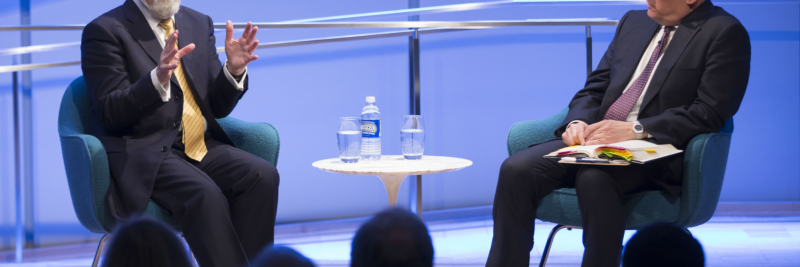
On 22nd March 2016, Rabbi Sacks was in conversation with Cliff Chanin, Vice-President for Education and Public Programs at the 9/11 Memorial Museum about the complex connection between religion and violence, the influence of extremism on young adults, and the potential of faith to promote peace.
Alice Greenwald, Director of the 9/11 Memorial Museum: [Opening remarks]
Cliff Channon, Moderator: Thank you very much, Alice and Rabbi Sacks. Welcome.
Rabbi Sacks: Thank you.
Cliff: As Alice indicated, the programme that we might have envisioned for last night is not going to be necessarily the same as we pursue this evening. As she indicated, your book is about confrontation with the very ideas underlying religious violence; an attempt to challenge them, an attempt to find a textual refutation of them.
But I want to start because on a day like this, when religion is invoked in the name of inhumanity, I want to turn to the question of interfaith understanding. We had, last September, the visit of the Pope, and the interfaith service that we had here with representatives of all of the world's great religions, some reciting their prayers, and all coming together in a common hope. It seems to me that one of the potential victims of an event like the one that's happened in Brussels is that interfaith understanding could be dealt perhaps even a mortal blow under these circumstances.
So tell me about your own commitment to that work and how you see it in light of the awful nature of what happened today.
Rabbi Sacks: Thank you, Cliff, and thank you, Alice, and thank you for being here. Obviously, I begin just by expressing what I’m sure is the feeling of all of us, and our prayers are for the families of the victims.
We pray to God, [Hebrew] Who heals the brokenhearted and ministers to their wounds, that He gives strength to the families of the victims, and to the people of Brussels in this moment of sadness and grief.
The truth is, Cliff, that it was here, I mean, at Ground Zero, in January of 2002, when the World Economic Forum had been moved from Davos to New York for that one year, that the Archbishop of Canterbury, George Carey, and I, and religious leaders from around the world, imams, the Chief Rabbi of Israel, gurus from India, came together here, to stand together and pray at the still-smouldering ruins. And it was that moment that I saw so vividly that this is the great choice of the 21st century.
Religion has such power to move people, and it can do that to heal or to harm, to mend or to destroy. I said at the time, religion is like fire, and it warms, but it also burns, and we are the guardians of the flame. And at that moment, I realised each one of us, and each one of the world's faiths, has to take a stand.
Where are we? Are we going to stand side by side with our brothers and sisters of other faiths, or are we going to allow tragedy to divide us? And that's when I decided to write The Dignity of Difference.
Move on several years to 7th July 2005, when we had our terrorist incident in Britain. It was very interesting. Within 24 hours, the Home Secretary had gathered around his table in the Home Office the leaders of all the faiths in Britain, because, obviously, he wanted us to cool frayed relationships, because the worry in the Home Office - I later discovered - was not so much the direct casualties of the terrorist attack, but the fear that this would generate such a hostile reaction to the Muslim community, that there would be riots in several British cities. Actually, there were no riots in any British city, and I had to say to the Home Secretary that perhaps he didn't realise that all of us were close personal friends. We had really worked at that relationship.
We had tens of thousands of people gathering in Trafalgar Square just to express our grief, and it might have been a Jewish occasion. It was as chaotic as a Jewish occasion, but actually it was... And people were just being pushed on one by one, go and say a few words, say a prayer, say something. And I said to the then Mayor of London, I said, we've got the leaders of all the faiths here. Let's not do it one by one. Let's all go on together. And that, of course, not only made a huge impact on the crowd, it was televised, and it sent back those very affirming and healing feelings.
So it is precisely at moments like this, when people seek to drive us apart, that we have to stand together. And it is precisely at moments like this, when terrorists seek to terrify, that we have to hold strong and say, we will not yield to terror or to anger.
Cliff: Speak a little bit more, please, about what you see as the essence of the interfaith dialogue. These are profound differences among believers in different faiths. So there has to be a level of reconciliation that is not simply about finally agreeing on all things. How do you find the balance between the agreements that you can find and the areas of disagreement that must be preserved for each faith to maintain its integrity and its wholeness?
Rabbi Sacks: After the assassination of the late Yitzchak Rabin, I was asked to do a television program by the BBC on the prospects for peace and so on, what all this meant.
And I went, it's the only time I've been there, to Amman in Jordan, to have a conversation with King Hussein at the time. Actually, he was taken very ill. And so I had a conversation with his brother, Prince Hassan.
He's a remarkable, wonderful human being, who is a real force for interfaith understanding and for moderation within Islam. And I said to him, what will bring us together?
And he said two things. Number one, al-Andalus. The fact that in Spain, in the 10th to 12th centuries, Jews, Christians, and Muslims did live together under very generous Islamic rule, very broad-minded. That was the great era of the great Islamic philosophers, Averroes, Avicenna, and so on, who had such an impact on Judaism through Maimonides and Christianity through Aquinas. It was called Convivencia.
In other words, the fact that we'd done it once shows that we can do it again. That was his first thing. But it was his second answer that I think speaks to your question.
He said, our shared tears. We both know what it's like to suffer.
And I suddenly thought when he said those words, the words of Maimonides in The Guide for the Perplexed, he's talking about somebody who killed somebody accidentally and he gets sent to the cities of refuge until the death of the High Priest.
And Maimonides says, what's the death of the High Priest got to do with it? Maimonides says, grief is something that can actually unite people. And therefore, I think it's precisely at a moment like this that you can say to Muslims and you can say to Christians and you say, let our tears bring us together. We've all suffered, we've all lost, and let those tears bring us together.
Cliff: Now in the book you do make reference to efforts by Muslim clergy to distinguish their faith and their beliefs from the claims that are made on its behalf by the killers in places like Brussels. There's always some sort of polemic about this as to why it's not enough or why it's not heard loudly enough and so on and so forth. I wonder if you have a view of whether or not there is anything that can finally be said that stands up to the kind of blood and violence that we see in places like that.
Rabbi Sacks: Well, the truth is, as any Muslim scholar knows, and as anyone knows, suicide is forbidden in Islamic law. Suicide bombing is certainly forbidden. Killing the innocent is certainly forbidden.
And who were these people struck down at random in Brussels at an airport and at a bus station? I mean, all of this is forbidden in Islamic law, and it is only a highly extreme version of Islam, which 100 years ago was a tiny marginal presence, Wahhabi Islam, which, for various reasons, has dominated the world of Islam more recently. But everyone knows that was, once upon a time, a marginal phenomenon in Islam. So the question is, how is it that this voice gets heard by the suicide bombers and the jihadists? First of all, as we know, many of the jihadists know almost nothing about Islam. One of them was found with a book, “Islam for Dummies.” So they're clearly not being driven by theological conviction.
But secondly, I'll tell you what is happening.
You know, there was a guy called Daniel Goleman who wrote a book called Emotional Intelligence. And as you know, there's such a thing as emotional unintelligence. We have this twin-track brain; Daniel Kahneman calls it “thinking fast and slow.”
We have a very sensible brain called the prefrontal cortex, which is wise, but it's slow. And we have a very emotional brain, which is quite stupid, but it's very fast. And if you're being chased by a lion or something, it's quite useful. You know, you don't sit and philosophise, you just get the hell out of there. And the deepest, quickest, most powerful reaction comes from this thing called the amygdala, which is the fear and fight-and-flight reaction. And that can flood out everything else.
He calls it an amygdala hijack. What ISIS have been doing has been flooding the social media with pictures of Muslims being attacked, humiliated, offended, all the rest of it. And this creates an amygdala hijack.
It makes some kids who are fairly unstable, fairly unrooted in a community, very volatile. And once they've got that fight-or-flight reaction, no theological nicety and no reasoning is going to help. And that is the danger.
Cliff: Now let me take us into the book for a moment, because you have a chapter which you call “Hard Texts,” which is an explanation of the phenomenon of people who seize on the most hostile texts within various religious traditions. You start by citing some of the difficult passages in Deuteronomy in the Jewish tradition. You say, I'm going to quote here, “These texts - and there are notorious examples in the New Testament, the Koran and the Hadith also - require the most careful interpretation if they are not to do great harm. That is why every text-based religion develops its own traditions of interpretation. Rabbinic Judaism declared Biblicism, accepting the authority of the written word, while rejecting oral tradition, which was the position of the Sadducees and the Karaites, as heresy. The rabbis said, one who translates a verse literally is a liar.” “The point is clear,” you go on, “No text without interpretation, no interpretation without tradition, or as two Corinthians put it, the letter kills, but the spirit gives life.”
So these are long traditions within all the faiths. You go into considerable detail in relation to certain Jewish texts and the difficulties that they have in this book, but this notion that fundamentalism short-circuits interpretation, that takes a strictly literal reading, and only a literal reading of these words, is essentially undercutting centuries of tradition within the very faith it's trying to defend or speak for.
Rabbi Sacks: That is the trouble. When you activate people's sense of collective humiliation, when you feel their people is being betrayed and you are being called on to make the ultimate sacrifice for the sake of others, all the normal reflexes are not there, and in any case, it's always small cells that radicalise, and those cells control access to information. But Judaism, Christianity, and Islam all developed very similar oral traditions.
What we call Midrash, the whole oral tradition. Christianity developed almost a parallel of the three or four levels of interpretation, which in Judaism are called Peshat, Remez, Drush, and Sod, et cetera, et cetera. And Islam had its tradition of jihad, and the various four schools of Islamic jurisprudence.
So you're dealing here with an attempt to bypass that whole tradition. So the question is, what is going to stop that? Fundamentalism. I give three definitions of fundamentalism, because fundamentalism is a complex phenomenon.
One definition is, fundamentalism is the attempt to move from text to application without interpretation. You just read the verse literally. Now, every sacred literature has got verses which you've read literally and acted on, which bring about catastrophe. There's not one tradition that doesn't have it.
Secondly, there is a second thing that fundamentalists try and do, which Judaism, Christianity, and Islam all say you're not allowed to do, which is impose truth by force. And you try and terrify people into accepting something that you hold dear.
That is not on. You remember in the Talmud, it says that when God came to make the covenant with Israel, and they're all standing by Mount Sinai, he lifted the mountain above their heads and said, you have a completely free choice. If you agree, fine. If not, that's going to be, I'm going to drop the mountain on your head. And the rabbis say - I mean, there's not even a hint of this in the Bible - but the rabbis say if that's the case, that invalidates the whole of Judaism. In other words, the attempt to impose truth by force is not on in Judaism, even when done by God Himself.
Now, the Koran quite explicitly says no compulsion in religion. And that is a common factor in those three faiths. It's what ultimately led, in John Locke's letter on toleration, to the birth of religious liberty in the West, where people began to see what it's actually like when faiths fight against one another.
And finally, my most controversial definition of fundamentalism is, it is the attempt to impose a single truth on a plural world.
Because I believe that the miracle of monotheism is not one God, one truth, one way. The miracle of monotheism is that unity up there creates diversity down here.
And we know of this through the Bible, through the opening chapters of Genesis. God delights in diversity. Genesis 10 - this is before the Tower of Babel - divides humanity into 70 nations and 70 languages. You know, God loves diversity.
So those are the three definitions. And the trouble is, none of them works when you're dealing with a potential suicide bomb.
Cliff: Let me go now more towards the argument you make in the book. And I will say that though you make references in the book at relevant points to Christian and Islamic texts, this is fundamentally a look into the depths of Genesis in particular, and particular stories within Genesis.
Rabbi Sacks: Let me explain why, Cliff. You know, I as a Jew should not be standing up criticising Islam or Christianity. The only criticism worth having is the criticism that comes from within.
So I was faced with a really difficult problem. I mean, if it is the case that at the moment the biggest ferment is within Islam, what's a Jew or a Christian supposed to say? Because we can't. But on the other hand, I really worried about one thing. You remember Martin Luther King? “In the end, we will remember not the words of our enemies, but the silence of our friends.”
And I did not want good, courageous, moderate Muslims - of whom there are many, and very heroic. And I want to say that the most heroic Muslims today are very often women. They are the real courageous voices, many of them.
And I did not want it to be said that their friends were silent. So I said, how can I do this? And I said, OK, I'll criticise ourselves. You know, in other words, what I'm saying to Muslims is where you are today, Jews have been, Christians have been, Jews were several times in their history, Christians were in the 16th and 17th century.
So I focused on the Jewish texts because I did not want to be in a position of telling Muslims what to believe as Muslims. But at the same time, I wanted them to know that they have friends who are willing to stand with them if they are going to speak to the better angels of their own tradition.
Cliff: Let me quote then from the book because you do take the issue of violence in the name of faith back to its Jewish sources, which is to say its first sources, since Judaism precedes Christianity and Islam.
I will read a brief excerpt here: “It turns out that there was tension from the very beginning long before there was a Christianity or Islam. The key narratives are in the book of Genesis. It is there that the drama of choice began. Isaac but not Ishmael, Jacob but not Esau. It was not some late development 2,000 years ago. It existed before then within Judaism itself. It must therefore be a problem in Jewish, not just Christian and Islamic theology. This is quite unexpected.”
Now, the problem that you're talking about is the problem of envy, the problem of exclusion and expulsion, the problem of resentment within families, within groups, and how difference provokes conflict among them. Taking it back to the Jewish source takes us back to the origin of the faiths of Abraham. The story that you dwell on with fascinating detail is the story of Isaac and Ishmael.
And the classic interpretation, which you recount, is the favor of God for the younger son, displacing his older brother, and therefore creating a narrative of ongoing historic resentment. But you turn that narrative upside down through the course of your analysis. There's a lot there, so we may not have time to do all of this, but I wonder if you could summarise the point and emphasise, if you would, that turning, where this is not a story of rejection and exclusion of one against the other. It turns out to be the story of two people on parallel tracks.
Rabbi Sacks: On the first day of the Jewish New Year, we read in the Synagogue Genesis 21, which begins by being a very happy story. Sarah, after waiting a lifetime, has a child, and that child is called Isaac, “He will laugh,” and she says, “God has made laughter for me. Everyone will rejoice with me,” and it's great. But then comes a very searing narrative, because Sarah, as Isaac is growing up, sees Ishmael mocking, whatever that means, and she says to Abraham, I don't want my son to grow up with his half-brother, Ishmael.
And if you remember, Abraham is very reluctant, but ultimately, he does send Hagar and her son Ishmael away. And there's a very powerful scene in the Bible in which their water runs out. They're in the desert. They're dehydrated. And Ishmael's about to die, and Hagar can't bear to look, and she puts him under a little bush to give him what little shelter there is, and she goes away in the distance. It's a horrendous passage.
And I want you to - are you familiar with this story? Because I'm going to presume some familiarity here. But when I read this story, when I read this story in the context of knowing that Jews and Christians trace their descent through Isaac, whereas Muslims trace their descent through Ishmael, I suddenly realised this is a very powerful story here. I'm not the first person to say it has to do with Jewish-Muslim relations. Nachmanides says this in the 13th century.
But a number of things strike me. Number one, when you read this story, who do you sympathise with? You sympathise with Hagar and Ishmael.
There's no way you can't sympathise with them. It's written so that you must sympathise with them.
And yet it was Isaac who was chosen.
So, something very strange is going on here, number one.
And of course, you remember how the story ends. An angel of the Lord comes down to Hagar and provides a well, et cetera, et cetera, and promises that God will be with your son. Ishmael lives, and God is with him, and so on and so forth. So it's clear that whereas Sarah may have rejected Ishmael, God has not rejected Ishmael. That's number one.
Number two, when you read the story of Genesis 24, when Abraham dies, who buries him? Isaac and Ishmael. They're standing together. Now, how did they get together?
Number three, when Abraham's servant, Eliezer, comes with the wife - he's, you know, I mean, the first Jewish father, you know, let's make a shidduch, who's got a match for my son, a nice Jewish boy, et cetera, et cetera - and the servant comes back with Rebecca, and they see in the distance Isaac coming “mibe’er lachai ro’i,” from the well of lachai ro’i. What is that well? What's it doing? He has played no part in the story so far. And the answer is, if you go back to Genesis 21, that was the well where we found Hagar and Ishmael.
Isaac has just come from visiting Ishmael and Hagar. And then you remember the curious story, very curious story, that Abraham, after Sarah dies, marries a new wife called Keturah and has six children by her. Extraordinary story.
The rabbis putting all this together, in a 7th or 8th century midrash, say as follows. They give two different readings. Reading one, Isaac said to himself, my father is worrying about me and has got a wife for me. Shall I not worry about my father? Because my mother has died. He's left a widower. So he goes to Ishmael and to Hagar and brings them back.
And Abraham remarries the one who was once his wife's slave, Hagar, and she's called in the Bible Keturah for whatever reason. I needn't go into that detail. Because, etc.
The other reading is even more profound, which is that Abraham, we know - you can see it in the biblical text - is reluctant to let Ishmael go. And it is Abraham himself who visits Ishmael, promising Sarah he won't stay overnight, he'll just go, see how he's doing. And he goes and Ishmael's not there and he finds he's married to a wife called, is it Ayesha or something or other, and doesn't like her very much, etc.
And it is Abraham himself who brings back Ishmael. Now the interesting thing is there are two wives of Ishmael in the Midrash and these were both wives of Muhammad.
Cliff: The same names?
Rabbi Sacks: The same names. In other words, the author of this Midrash knows about Islam, knows Islam traces its descent through Ishmael, and has given an interpretation of the narrative that brings them back within the family and they're standing together. And this Midrash, I mean, you think interfaith was born after the Holocaust. This is a real interfaith Midrash.
It's a way of saying there are hints, clues, anomalies in the biblical text that are best understood by saying in the end, whether it was Abraham himself or Isaac, who brought back Ishmael into the family because God never rejected Ishmael.
So what I'm saying is this, that if René Girard, the great French scholar on religion and violence, “Violence and the Sacred,” Sigmund Freud himself, who understood that sibling rivalry is a fundamental driver of violence. I argue in the book that Judaism, Christianity, and Islam build within their own narratives an ongoing sibling rivalry. And if that's the problem, then the Bible itself contains the solution if we read it the way the rabbis read it in the Midrash. Because the fact that God chooses Isaac does not mean he rejects Ishmael.
And all of sibling rivalry - wait, guys, do we have any parents in the room? Did you ever encounter sibling rivalry among your kids? What is it that when Mum is paying attention to my brother or my sister upsets me? What is it? Why is she caring about him when she should be helping me? In other words, sibling rivalry is always - whether in the animal kingdom or in the human family - to do with scarcity. She loves him and she doesn't love me. That's what sibling rivalry is about.
Now to suppose that God's love obeys the logic of scarcity is simply not to understand what God's love is about.
It is not in finite supply such that if he loves me, he doesn't like you. In which case, that whole sibling rivalry, which created animosity and tension for centuries between Jews, Christians, and Muslims - as I explain in the book - is built on a false supposition.
And actually, God's love is simply not finite, such that in choosing me, he doesn't reject you.
Now, is this going to change the mind of any potential suicide bomber? Let me be terribly blunt with you. No. If you're about to conduct jihad, you don't sit down and read a book by a rabbi. I'll be honest. But what I want to do, Cliff, in this, is to say to young Muslims, guys, there is another way. And what's more, we as Jews and you as Christians are going to walk side by side with you on this way, because God has made many faiths, but only one world in which we have to learn to live with one another.
And we now are so interconnected that unless we learn to make space for one another, we will not be honoring either God or humankind. And that's really the argument of the book.
Cliff: Do you find ways to bring this argument to young people in the UK or here? Jewish certainly would have an audience for that, but Christian, Muslim youth, have you found ways to take this and make the case in front of them and engage with them on the concerns that they have? What are the questions that you get that challenge your argument?
Rabbi Sacks: I give talks in front of mixed audiences and the first people who come up buying a book for me to sign are always Muslims.
They love this. Why do they love it? Because deep down, the mainstream of Islam is not the kind of Islam that's capturing the headlines. These kids come from families that know this is not the Islam their parents knew, their grandparents knew.
And of course they're not hearing a loud voice within their own faith talking moderation. But when they're hearing it from somebody of another faith who is respectful of their faith, instead of looking down on them and blaming them for the problems of the world; who is empathising with them, this really, really speaks to young Muslims. And almost always they're the first in the queue.
And I have to say to you, I wouldn't have written a book without road testing it first. A rabbi doesn't road test a book with Jews. They're never going to agree with you anyway.
The point is, if you're trying to reach out to people of other faiths, you've got to test it against people of other faiths. I wrote this book, as Alice mentioned, called “Dignity of Difference.” I wanted to know, does this work? I mean, this works for me as a Jew, but does this work for a Christian?
I used to meet together with groups, student leaders in Britain, not Jewish. They came from all sorts of faiths. And I road-tested this idea with them. And I was seeing them, the Sikhs, the Hindus, walking out half an inch taller than they came in.
And you could write the words in the think bubble above their head, you know. And you could see them thinking, well, we always knew we were different, but we always thought that was a bad thing. And here's the Chief Rabbi telling us it's a good thing.
And I suddenly saw it made sense for them. It made them feel very affirmed. So, by and large, I don't publish books without road-testing them first against the people that I want to influence.
Cliff: Violence and the recourse to violence, you think of it as something that actually precedes any religion, that it is in the earliest parts of Genesis.
Rabbi Sacks: Well, it's Cain and Abel.
Cliff: Yeah. God's regret at his creation because of the violence expressed by human beings.
And yet, you use biblical sources, you use Rene Girard, you use Freud to focus on the presence of violence in our inner essence. What is the relationship between religion and violence? People blame religion because of events like today for the expression of violence. But can you separate the two, and how is it distinguished when each of these religions has violence in its own history, whether in its texts or its practices?
Rabbi Sacks: Look, it's very clear that the Bible is about an attempt to moralise power.
Violence is the attempt to impose my will on the world, if necessary, by coercing you. And if you refuse to be coerced, then I'm going to kill you. It is what I call the will to power.
And the first Nietzschean is Cain. You know, Cain offers something to God, God does not accept it, so Cain says, well, okay, in that case, I'm going to eliminate my brother, and so there's only going to be me left. And the Bible is the attempt to moralise power.
And I say in the book that that is going to be the fundamental choice in the 21st century, as it has been for many other times in human history, which wins? The will to power or the will to life.
In the end, it is this extraordinary statement, not only in Genesis 1, but in Genesis 9. In Genesis 1, God says, “Let us make man in our image, according to our likeness.” Genesis 9, after God has seen a world filled with violence, and after it says, “God regretted…” that He had ever created man in the first place, and after the flood, God then says to Noah, “He who sheds the blood of man shall have his blood shed by man,” because He made man in His image.
In other words, Genesis 1 tells me I am in God's image. Genesis 9 tells me you are in God's image.
And that is the Bible's ultimate statement against violence.
If you can recognise the image of God in another human being, then you realise that other human life is sacred.
Now, it's a very powerful idea. All of human civilisation depends on that idea.
The very birth in the 17th century of the concept of human rights, the 1948 United Nations Universal Declaration of Human Rights, all of those are predicated on that idea. And that is why Christianity and Islam have their own traditions - limiting war, limiting violence, and absolutely forbidding terror, that is violence against the innocent. So, you know, religions have all had bloody pasts because the trouble is not religion.
You know, there used to be a car. Do you remember? An advert for a car designed by robots driven by idiots. Do you remember that? You know, the trouble is not the car. The trouble is the guy driving the car. So the trouble is not the universe. We, the human mind, is the great weapon of mass destruction. That's the problem.
And God made us physical beings with physical desires. And the end result is we can have the course to violence to satisfy our desires.
And God could have taken away our freedom. He didn't do so. It is categorical in Genesis 4 when he sees that Cain is in danger of an act of violence. God warns him, but He doesn't stop him. So, somehow or other, that is the human condition. We have this huge propensity for violence, and every major religion in the world has yielded to it sometime.
Today, there's violence being perpetrated by Hindu nationalists, by Sikhs in India, by Buddhists in Myanmar and Sri Lanka. Now, these are not inherently violent religions, but the trouble is religion designed by God but driven by human beings. And the problem of violence is the problem of humanity.
It doesn't matter whether you have a religious culture or a secular one. One way or another, violence is always just beneath the surface.
Cliff: But you do point a finger even at monotheism in relation to this.
Let me read. “A humanitarian, as opposed to a group ethic, requires the most difficult of all imaginative exercises. Role reversal, putting yourself in the place of those you despise or pity or simply do not understand.
Empathy across boundaries can sometimes threaten religion at its roots because one of the sacred tasks of religion is boundary maintenance. That is why, historically, the great monotheisms have not been in the vanguard of tolerance.”
Rabbi Sacks: Cliff, I thought if you're dealing with a phenomenon of this seriousness, be absolutely, relentlessly honest.
Am I supposed to get up and say religion is for peace and therefore if everyone had my religion the world would be at peace? Let's be honest. We know that in our sacred texts, there are very, very violent passages which we have to wrestle with. We know perfectly well that there have been blood-stained episodes in the history of our faith, whatever that faith happens to be.
I didn't think I was going to be useful at all unless I was absolutely, blatantly honest and self-critical on this. I think in the end that's what speaks to people.
Let's not pretend we're great and you're terrible. That is the problem, not the solution. So, yes, any ideology can yield to violence and religion because it so binds me to other people, estranges me from the people who aren't of my faith. Every human group binds and blinds.
It binds us together as a “We” and it defines us against a “Them,” and therefore it divides as it unites. You know how to unite any group that's squabbling? Invent an external enemy. So you unify by dividing and that is the phenomenon of human groupishness.
And that really goes to the roots of human nature and the roots of any social animal. So I've tried in this book to be very, very honest. But it is a hopeful book.
Cliff: It is. I want to come to a moment of hope. Otherwise, don't look at me that way.
You say Abraham and you come back to Abraham and this is not coincidental. The father of your faith but the father of the faiths you are addressing in this book. You say, “Abraham offers a truth for the 21st century. He seeks to be true to his faith while being a blessing to others regardless of their faith and here we have the Isaac and Ishmael story in its essence, its 21st century essence.”
You go on, “The ethical imperative to emerge from such a faith is search for the trace of God in the face of the other. Never believe that God is defined by and confined to people like you. “
Rabbi Sacks: That is a paraphrase of a wonderful passage in the Mishnah, 2nd, 3rd century, Sanhedrin chapter 4, where it says something really powerful.
It says when a human being makes many coins in the same mold, they all come out the same. God makes all of us in the same mould, in the same image, His image, and we all come out different.
It's a brilliant rabbinic saying of almost 2,000 years ago and if that is true, that we're all in God's image but we're all different, it means that the real religious challenge is can I see God's image in somebody who's not in my image? Someone whose language and culture and creed are different from mine? And that is the religious challenge.
Now, you know, I think it's a very, very powerful challenge. I've said also that I think the biblical narrative is really deep and subtle because as we saw in the story of Isaac and Ishmael, all our sympathies are with Isaac and yet when we read the story suddenly we have to change our vantage point and see things from the other side, from how it looks to Hagar, how it feels to Ishmael, and it happens again with Jacob and Esau. You remember the story where Jacob steals Esau's blessing and he takes it and out he goes, and in comes Esau and there's this extraordinary moment when Isaac suddenly realises what has happened, and Esau suddenly realises and this laconic text of Genesis, which almost never describes anyone's emotions, you know how few the... But there, all of a sudden, “Isaac trembled, a great and exceeding trembling,”... “And Esau let out an exceedingly bitter cry.”
These are the most emotional phrases in the whole of the Mosaic books and all of a sudden, having been with Rebecca and Jacob, we're suddenly on the other side with Isaac and Esau.
Okay, we know Esau's not perfect. Okay, Esau's not going to win the Nobel Peace Prize. He's not going to become the Dalai Lama, but he's still a decent human being who loves his father and his father loves him, and the Bible is forcing us to see things from the other side. The way I tell the story in the book is actually a true story.
There was a young, very anti-Semitic politician in Hungary, a potential leader of something called the Jobbik Party, which is a very right-wing, nationalist and pretty anti-Semitic party.
His name was... Csarnad Szegedi, and he's a young guy who's clearly going to… rise to the top and his opponents want to stop his career path and they dig around into his family's past to see if they can find anything to discredit him with, and lo and behold, they discover that his grandparents died in Auschwitz. This leading Hungarian anti-Semite discovers one day, I'm a Jew, which is, you know, a fairly sobering discovery if you're an anti-Semite. It doesn't stop people but, you know, it's... And I suddenly realised that's what the Bible is forcing us to do.
Do a role reversal. If you want to cure an anti-Semite, prove to him he's a Jew. And that actually is what the Bible is saying in one of its most powerful lines, Exodus 23: “Do not oppress a stranger. You know what it feels like to be a stranger. That's what you went through in the land of Egypt.”
Just remember your past. You were once the other side. And that is why I think the most powerful moral force is not reason, emotion, sympathy, empathy. It's role reversal.
If you can actually think your way in to the other side, then you suddenly discover that your enemy is also a human, and that somebody who has a different religion from you nonetheless carries within him or her the image of God.
Now, if that is the case, then you suddenly have an argument for tolerance that's very, very religious.
And let me be blunt with you. One of the most striking things about Islam is that it generates deep religiosity among its followers. It is the most immune of all the world's faiths to secularisation.
So if you can speak... And this book I deliberately wrote as a very religious book. I could have written it as a completely secular book. But I deliberately wrote it as a religious book, because if religion is the problem, then it ought to be the solution. Otherwise, you're going to really fail. You're going to miss the point.
Somebody just did a study. It was published a week ago on the Israeli-Palestinian peace process. And they analysed what was dealt with, why did it go wrong, and all the rest of it. And the finding was fascinating.
It said that peace process, you know, the Oslo process, which lasted from 1993 to September 29, 2000, when it all fell apart, covered every single aspect of the Israeli-Palestinian conflict except one. The religious one. Now, go figure. This actually could have been part of the solution.
But since it was never touched on, it remained part, and an increasingly big part of the problem. I once... Tony Blair. You remember him. He was our Prime Minister. He was a very religious man. But British politics is different from American politics. You don't talk about religion in public. You may have had separation of Church and State. But we actually kind of... And we never had that because we have an established Church.
But woebetide the politician who talks about religion in public in Britain. Because we're very, very secular culture. So whenever anyone asked Tony Blair about his religious beliefs while he was Prime Minister, his press officer interrupted and said, we don't do God. Just cut it off dead. So when Tony Blair retired, or resigned from being Prime Minister, I phoned him up and I said, you're no longer Prime Minister, you can do God.
So I did the first interview with Tony Blair for BBC television after he had ceased to be Prime Minister. And that was a fascinating interview because as well as talking about his own personal faith, I asked him, did it have an impact on his work as Prime Minister? And he said, yes. And this is what helped me solve the Northern Ireland peace process. You know, the Protestant-Catholic thing.
Don't forget Tony Blair at the time was a Protestant married to a Catholic. He eventually converted to Catholicism, but he hadn't yet. He said everyone else, in dealing with the Northern Ireland peace process, saw religion as the problem. I saw it as part of the solution. And, you know, to be able to say in public on BBC television that it was my religiosity that allowed me to bring Protestants and Catholics together because I didn't skirt it, I didn't avoid it. I dealt with it head on and respectfully head on. I think that sends a very powerful message that if you actually bring religion into this, it is indeed part of the problem. But my argument is it really could be part of the solution.
Cliff: More than you make the argument in the book that the 21st century is going to be a time of de-secularisation, that we have come to this point as a more and more secular society, but just in terms of the way the world's population is growing, that the de-secularisation will spread, that there will be more religious people with more deeply felt views, and the question is are those views going to be destructive or are those views going to come to some sort of harmonious coexistence?
Rabbi Sacks: I mean, this was the assumption from the 18th century onwards, that secularisation was a linear and irreversible process and that religion was, if not yet dead, in intensive care and on life support. It was going to die soon.
And we now know that that isn't the case. And in virtually every part of the world, the more religious you are, the more children you have. And today, you know, for a population to be stable, there have to be 2.1 children per female of the population, which in America is, I think, your birth rate.
There's not one country in the whole of Europe that has a 2.1 birth rate. Britain is among the highest with a 1.8 birth rate. Spain, Italy, 1.3. The lowest birth rate in the world at 1.27 is Germany.
So Europe is actually dying. The only way Europe is able to maintain its population is by unprecedented levels of immigration. And this is what's creating all the ferment in Europe, and this is what makes it so hard to deal with the situation that led to the tragedy in Brussels and the tragedy before that in Paris and all around Europe. Cologne, Spain, and all the rest of it.
So, simply actuarially, even if not one sceptic is persuaded to believe, in the whole of the 21st century, the 21st century will become more religious the further into it we get, and more religious than the 20th century. So, religion is going to be an absolutely fundamental feature of the politics of the 21st century, increasingly so. So it's going to get more and more important which voice of religion prevails.
Cliff: We've been speaking for an hour, but it seems like ten minutes. So I'm surprised to look at my watch. I want to give the audience a chance to ask a question. And please keep your questions brief so we can squeeze in a few more. I'm going to ask that you wait until the microphone is brought to you.So we have the two mics on either side of the room. This gentleman here will start with you.
Questioner: Hello, Rabbi.
Rabbi Sacks: Hi.
Questioner: You say, and I agree with you, that God created many faiths, right? And I, as a Jew, have come across it because I've traveled plenty. But from my experience, and I can only speak from a Jewish experience, I've come across many rabbis that use the idea of we're the chosen ones and that everything else is null and that Jesus was a mamzer and that Hindus are idol worshipers.
And I believe we, to a certain degree, are creating the distance as well. And unfortunately, from my experiences, we don't see - or I don't see - leadership such as yours. I see rabbis that are not as enlightened as you are, preaching hate disguised as power and knowledge of Torah.
So if you were me in my position, how would you go about that?
Rabbi Sacks: Well, I'm sorry to admit that you're quite right. Mine is not the only voice. I would say it's probably a minority voice. So what do you do in a situation when you are pretty convinced that many rabbis are part of the problem, not part of the solution? Well, the first thing you do is you become Chief Rabbi. It helps a great deal. So we were able in Britain to develop a rabbinate that did not talk in the terms that you're referring to.
I absolutely forbade that kind of language, and the young rabbis really responded. I mean, it was a bit of a shock. I don't know if you know this, but when my book, “Dignity of Difference,” was published, I was actually accused of heresy, and people wanted to excommunicate me, which made it extremely useful that I was Chief Rabbi because I was the only one doing the excommunications.
The book, “Not in God's Name,” has now been translated into Hebrew and will be launched in May in Israel. I will be launching it there. And of course, as you know, for the past two and a half years, I've spent a lot of my time here in the States.
In other words, I don't take it as sufficient that I have delivered a message which is a voice within Judaism. I have to spread this message within Judaism, and I've tried to do so within Britain and the Commonwealth. Now I'm trying to do so in America, and over the next few years, try and do so in Israel, because what you say is sadly true, and it's not getting better. It's getting worse, actually, because the Middle East has this ability to radicalise all sides. Once one side is radicalised, everyone gets radicalised. And so the point you make is very valid, and I simply want to say that, you know, having made this argument now for the last 10 or 15 years, I do find that I have persuaded many young rabbis that this is the way forward.
Cliff: Let me ask in relation to that very question you evoked, the Middle East. The Israel-Palestine dispute, which has become, as you say, more religious, more intensely rooted, also has an enormous effect on populations worldwide. And so is this something that can be separated from the kind of reconciliation that you're hoping for, or does it require some sort of settlement to be able to reach past it into a reconciliation?
Rabbi Sacks: Well, it's clear that the Israel-Palestinian conflict is fanning the flames worldwide, because given this instantaneous global communication, don't forget the whole power of al-Qaeda and ISIS is predicated on modern methods of communication.
And it is when there's a revolution in information technology, that groups that at other times would be marginal, have this ability to reach vast swathes of people, and that's why Europe was seized by wars of religion in the 16th and 17th century, because of their information technology revolution, which was called the invention of printing. That was what had that impact. So, the result of instantaneous global communication is that a conflict anywhere very rapidly becomes a conflict everywhere.
So the Israel-Palestinian conflict becomes a conflict on British university campuses, American university campuses, you name it. And therefore it's really, really central to all of this. But you will notice that if I had mentioned the Israel-Palestinian conflict in the book, in even one sentence - well, I do, sort of - but in even one sentence, everyone would have ignored the rest of the book and just focused on that sentence.
So I had to take it out of the book because it has to be dealt with as a separate topic. Otherwise, it creates this amygdala hijack. Everyone gets so intense about it that it stops them being able to hear some other important statements. So yes, it's relevant, but no, I kept it out of the book because I knew it would hijack the book if I included it.
Cliff: Who else? Yes, the lady there in the middle of the row. Just wait for the mic, please.
Questioner: In terms of confronting the religious violence part of it, given that the people who are the fundamentalist violent type, such as ISIS and al-Qaeda, realistically, collectively, is there anything that we can do to stop that? Because are they so far beyond reason that other than bringing down more violence through military or other forms, is there any way to stop those people?
Rabbi Sacks: What we are dealing with here is a phenomenon that was two generations in the making. Well, you know, the Muslim Brotherhood was founded in 1928. It was a direct reaction to the end of the Ottoman Empire.
The Ottoman Empire was the last remaining major embodiment of Islam as a political power. And the belief was, you know, of Kemal Atatürk and the attempt to secularise Turkey, that Islam could meet the modern world through this process of secularisation and westernisation. And that created the counter-reaction of the Muslim Brotherhood by Hasan Banerjee in 1928.
And there are various milestones along the way. But it was basically in 1973, with the hike in oil prices, that the Gulf states were able to, with this huge new wealth, build systems of madrasas throughout Pakistan, and especially teaching Wahhabi Islam. So something that had become... was initially quite marginal became a global phenomenon.
Most of this radicalism had its origin in those madrasas. So I've said that we have to adopt a similar long-term approach to this. Because people are beginning to see that a phenomenon that religious... because we're dealing here with something that embraces al-Qaeda, ISIS, al-Nusra, al-Shabaab, Islamic jihad, and hundreds of others.
And everyone knows that, or at least a year ago, you could defeat ISIS militarily like that, overnight, if there were sufficient determination. That would end ISIS. But the phenomenon would return in another half a dozen new guises. Because we're dealing here with a move which is religious, cultural, social, economic, the whole thing. And you do not end those movements by military means alone. And people are beginning to slowly realise this.
The military defeat of ISIS is not going to be the end of the problem. It just isn't. And that is why I argue in the book that wars are won by weapons, but peace is won by ideas.
And ideas, therefore, take a process of education. And education takes a process of generations. And I tell you, this is our fundamental weakness. What is the... Can I ask a simple question? I went around asking in Britain this question for 10 years. What is the maximum attention span of a British politician, or a western politician? Maximum attention span.
Cliff: 30 seconds.
Rabbi Sacks: Until the next election. That's the maximum attention span, OK? Four years in America, five years in Britain. That's the maximum attention span.
We are dealing with a cultural phenomenon whose minimum unit of currency is the decade. They are thinking in terms of centuries. Bernard Lewis, the great teacher of Islamic ideas at Princeton, was trying to communicate this throughout a lifetime. Do understand that not everyone has the same time perspective, the same time horizons. We're dealing with a culture that thinks in terms of centuries.
So just as there is a phenomenon of flying beneath the radar in space, in spatial terms, so there's a phenomenon of flying beneath the radar in temporal terms.
When groups are operating in a time span that is beyond the maximum attention span of a western politician, no western politician will find an antidote, an answer, because they're just beneath the radar screen. So I'm trying to say, let us think as long-term as the people we are confronting. Let's begin now with the process of education, knowing that it may take 25 years minimum or 50 years ultimately, to produce a young generation of Muslim leaders, Christian leaders, Jewish leaders, Hindu, Sikhs, and so on, who are educated in that religious imperative of making space for difference.
Without that, we're not going to negotiate the 21st century. And that is why we've got to think long, think in terms of education, think in terms of beginning with the young, with the people who realise that religion has taken a wrong turning. Begin now and we'll win. But look for the quick fix and we'll lose.
Cliff: One more. There, please.
Questioner: Hi. Thank you, by the way. So something I hear all the time about Radical Islam is that when I try to defend the race, religion, the faith of Islam, people say that majority of Muslims are radical. Where I don't agree with that. But the reality is that the bully in the classroom is always the loudest. And people only hear the bully. So my question for you is how many Islamic leaders in the world believe in what meaning you believe in? In peace. And if that number is a lot, then why not gather those people and isolate the enemy? Isolate the radical beliefs that is ISIS, that is Hezbollah, that is Hamas, and take it to social media, take it to the world, and open everybody else's eyes on their beliefs. Because in today's world, I do believe that the education could be expedited because there are many eyes around.
Rabbi Sacks: You're absolutely right. As I said, the radical, the courageous voices in Islam, many of them are coming from women. I'm thinking of people like Irshad Manji in Toronto, Wafaa Sultan in California, Ayaan Hirsi Ali in Harvard, and so on.
There are very, very significant figures like Akbar Ahmed in the American University in Washington who had been the Pakistani High Commissioner in London. To give you a, for instance, what I did in England, you remember in 2002, well, sorry, you won't remember, but in 2002, an American journalist called Daniel Pearl was murdered in Karachi. And I did a television program for BBC in which I got Daniel's father, Judea Pearl, together with Akbar Ahmed, who was then Pakistani High Commissioner, and Daniel was murdered in Pakistan. I brought them together. I mean, they knew one another. And we filmed them in our home just talking through this issue.
And then I took them both, first to a Muslim school, the Islamia School in London, and then to a Jewish school in London. And we just tracked them, and it was the most extraordinary programme because they really became friends. And I said to Judea, you know, tell me, how did you reach this point? How did you cope with the pain of losing your son and become so generous?
And this is what he said:
“Hate killed my son. Therefore, I'm going to spend the rest of my life fighting hate.”
And that was a very powerful thing.
Then, another year, I took the cameras to an Orthodox Jewish day school in Birmingham, a junior school, under my aegis, called King David Birmingham, which is unusual in that more than half the pupils are Muslims. Very unusual. Because the Jewish population of Birmingham is no longer as big as it once was, so although all the [Jewish] kids in Birmingham go to this school, they're less than half of the school.
And I was able to film a wonderful Muslim father who explains to the cameras that he specially moved to that part of Birmingham so he could send his children to a Jewish school. And I spent the day with the kids. They're from 5 till 11, it's a junior school, teaching them the Israeli peace song, “Od Yavo Shalom Aleinu.” You know this song? Which they were singing in Hebrew and Arabic and English. And the camera is panning across these young kids, some Jewish wearing the yarmulke, some obviously Muslim, some Sikh, some Hindu, some Chinese, singing this peace song. And a number of viewers wrote to me saying there were tears in our eyes.
So you can use the media to portray a really, really positive message that is emotionally affecting, that makes sense, and that is delivering a religious message precisely the opposite one to the radicals. Have we done enough of that? No. So I'm going to be dedicating the next few years to seeing how far we can do this using those media because ISIS uses Facebook and YouTube.
And I believe we're going to have to see whether we can use this technology to deliver a message of peace that will lift spirits and that will help us build a safer world for the sake of our grandchildren not yet born.
Thank you very much indeed.
[Closing comments]