
Why the Rebbe’s Shofar Had a Different Sound
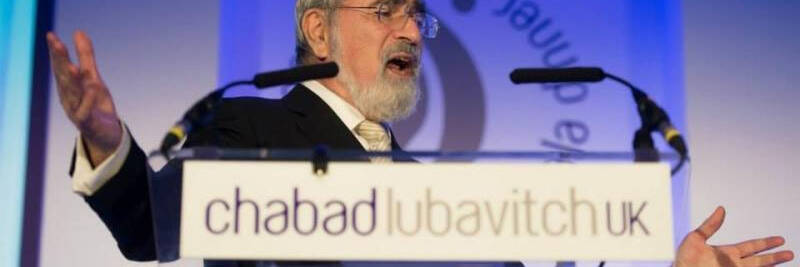
Chabad Lubavitch UK Annual Dinner, Marriott Grosvenor Square, London
Share
On 29 September 2014, Rabbi Sacks spoke at the Chabad Lubavitch UK's Annual Dinner, held at Marriott Grosvenor Square, London, where he presented a Lifetime Acheivement Award to Mrs. Fradel Sudak, honoring her achievements and those of her late husband, Rabbi Nachman Sudak. The guest of honour was Gennadiy Bogolyubov.
Audio courtesy of Chabad Lubavitch UK.
It’s an enormous privilege for Elaine and myself to join you in this great celebration of a great movement and a great force for good in Jewish life and the world.
And we’re doing so at a very powerful moment in the Jewish year. We’ve just celebrated Rosh Hashanah, and we’re on our way to Yom Kippur, which I’m going to need after this evening’s meal!
Let me share with you a story I shared with some friends at Marble Arch the other day, about a memory that came back to me this year about one very special Rosh Hashanah in my life.
A long time ago, 46 years ago, when I was a young student, I had the great privilege of meeting the Lubavitcher Rebbe – an extraordinary meeting that changed my life. I’ve told the story elsewhere, so I don’t want to tell it here.
But I was just about to go back to England. We’d come on a charter flight organised by the Union of Jewish Students, and it was leaving on Sunday. So, on the Shabbat the day before, I was in 770, and the Chassidim said, “If you’re going back to England, you have to take with you the Rebbe’s vodka.”
What was the Rebbe’s vodka? You went up at a farbrengen, where the Rebbe spoke. There were five or ten thousand people there, and in breaks between the speeches (I think we should have commercial breaks in the middle of my speeches!), when all the Chassidim were singing, people would go up to the Rebbe. They’d pour a glass of vodka, the Rebbe would say “L’chaim”, and you would take that back with you wherever you were going. That was the Rebbe’s vodka.
So, the day before I was due to leave, I went up to the Rebbe. The Rebbe looked at me and said, “You’re leaving?”
I said, “Yes.”
He said, “Why?”
I said, “I’m going back to university. The university term is about to begin.”
And he said to me, “But the Cambridge term doesn’t start until October.”
Now… we were having this little exchange in front of however many thousands there were, and this was not normal. You normally just said, “L’chaim.”
So, when I got back to my place on the benches, or bleachers, or whatever you call them, all the Chassidim wanted to know: “What did the Rebbe say? What did the Rebbe say?”
I said to them exactly what he’d said. I should never have done that. I really had no idea that when the Rebbe says, “I think you should stay,” you stay.
So, the next day, Chabad stopped me from getting a taxi to the airport. They forced me to miss my flight.
I said, “How am I going to get back? This was a charter flight.”
They said, “Don’t worry. We’ve told them you’re ill.”
I said, “In what way am I ill?”
They said, “Don’t worry. Tomorrow you’ll go to the Rebbe’s doctor. He’ll tell you.”
The next day, I went to the Rebbe’s doctor. He came out with a long, long list of possible illnesses: “Have you had this? Have you had that?”
I was saying, “No, no, no, no.”
Finally, after about 50 items, he came to jaundice.
“Have you ever had jaundice?”
I said, “Yes, ten years ago.”
He said, “Recurrence of jaundice…”
So that is how I got to spend Rosh Hashanah with the Lubavitcher Rebbe and hear the Rebbe blow shofar.
Now, that was an experience that stays with me from that day until this. I can still hear it. It was different in kind from any other shofar sound that I’d heard, and it puzzled me.
According to the Torah, there are two different explanations of the shofar. Teruah is the sound of tears, of weeping, of sobs and sighs. Or, according to the other explanation, it is a recollection of the ram that Abraham. It is the Akeidah, the Binding of Isaac, and hence a recollection of the many sacrifices Jews made over the centuries.
So, either way, it’s the sound of tears or it’s the sound of sacrifice. It’s a sad sound.
The Rebbe’s shofar was not a sad sound. And it bothered me. How was he blowing? What was he… Obviously, the Rebbe had mystical intentions that I would never understand. But many years later, I discovered what I think was the explanation.
Although everyone else explains the shofar as a sad sound, there’s one exception: the greatest rabbi of the Middle Ages, Moses Maimonides, who says that the shofar is God’s wake-up call.
You who shloof (slumber) during the year, wake up and realise that you only have one life to make a difference.
And the Rambam goes on to say something absolutely extraordinary, one of the most extraordinary remarks in the whole of Judaism.
He says that we know, according to the Sages, that our lives are judged by the majority of our deeds. If most of our deeds are good, we are written for good. And if most of them are bad, bad things happen to us. And so with a community, with a city, with a country, with the world.
The Rambam says that when you hear the shofar, you should think this: that your life is evenly balanced between good and bad, and the world is evenly balanced between good and bad. And your next act will tilt the balance of the world.
What a thing to say! It is the most unexpected thing anyone could say. We know there’s only one of us. There are seven billion people out there in the world. How do we make a difference? We are no more than a wave in the ocean, a grain of sand on the seashore, dust on the surface of infinity.
But the Rambam says, “No, you are not insignificant. Your next act could change the world.”
And that’s what I heard in the Rebbe’s [shofar]. And that is what he taught the whole Jewish world.
Friends, tonight we celebrate the achievements of two remarkable individuals who really did, and have, and continue to change the world.
First of all, our special guest, Gennady Bogolyubov, who has revolutionised Jewish life in Ukraine and who has done so much throughout the Jewish world.
In Ukraine, which we read about every day in the press, while others are fighting political and military battles, Gennady is making possible the most extraordinary spiritual victory for Jewish life in Ukraine.
Gennady's building a centre, it’s absolutely vast, it’s 32,000 square metres, I can’t even work out… And I thought, “How can you need such a big place for so few Jews in Ukraine?”
Now I realise they’re all fleeing from [inaudible - Eastern Ukraine conflict areas], and they’re all coming to Ukraine, all coming to Dnipropetrovsk. You say it, Gennady, I can’t even pronounce it!
But, one way or another, you’ve done incredible things. You have facilitated this wonderful project exposing the tunnels that run along the Kotel in Jerusalem. You’ve built a Jewish community centre in Vienna. You have done extraordinary things for Chabad around the world.
And why? Because, Gennady, as you told the shluchim when you addressed them before me - and I had a hard act to follow - I felt so moved at your speech because you said, “Chabad believed in me.”
And so you believe in your power, which is the Chabad power, to change the Jewish world. Gennady, we salute you.
And, of course, tonight we honour Rebbetzin Fradel Sudak, who, together with her late husband, Reb Nachman, has led and guided the destinies of Chabad in Britain for a very long time. When Rebbetzin Fradel and, l’havdil bein chaim l’chaim, Rabbi Nachman zt”l, of blessed memory, arrived here, there was Chabad.
Can you imagine Chabad trying to cheer up Anglo-Jewry? We were kind of boring on principle, you know. It was the toughest challenge anyone could possibly imagine.
And somehow, from nothing, under the guidance of the Sudaks, and now the next generation, you have turned Chabad in Britain into a vast organisation, with 11 campus centres, 25 Chabad houses and 14 schools. It is an incredible, incredible achievement.
Before Chabad appeared on the scene, could you imagine that one day Jews would light a menorah in Trafalgar Square? Could you imagine that they would serve Hashem with such joy? Could you imagine Jews sitting down and drinking vodka before the speeches, which turned out to be a very good idea?
Chabad has made us serve Hashem with joy and share that joy with others. And, Rebbetzin Fradel, you and your late husband changed our Jewish world.
Friends, I want you just to think about this. Rabbi Nachman Sudak was taken from us so sadly prematurely, at the early age of 78.
But I want you just to work it out. He and Rebbetzin Fradel began their shlichut here in 1959. He was head of Chabad in Britain for 55 years. The Rebbe sent the two of them to this vast challenge at the age of 23.
Everyone else spoke about young leadership. The Rebbe actually believed it and did it. And he could see that Rabbi Nachman, and l’havdil bein chaim l’chaim, Rebbetzin Fradel could change our Jewish world. And they did. And we salute the entire Sudak family.
Friends, right now, we need the Rebbe’s message.
We look at the news every single day, and we see a world filled with hatred and violence and death. That can lead us to very dark thoughts and dark places.
The Rebbe taught us that we can change the world if we bring the same passion, intensity and energy to love, to peace and to life. And that is what we are there to bring into this world.
The Rebbe believed, and heard in the shofar, this call from God for each of us to change the world. And the Rebbe did change the world.
Think of another rabbi in a thousand years who changed every single Jewish community in the world, and places where nobody ever dreamt there would be a Jewish community.
You want to escape from Jewish life? Go to Kathmandu. Do you know what you find in Kathmandu? The biggest Chabad Seder you’ll find anywhere in the world, 3,000 people for Seder night. You don’t escape yiddishkeit that easily, because there’s always Chabad ahead of you.
Friends, he really did change the world. How did he change the world? By blowing the shofar and teaching each of us that we, too, can change the world.
One life is an entire universe. All we have to do is change one life, and we have begun to change the world.
Friends, we no longer have the Rebbe, and sadly, deeply sadly, we no longer have Rabbi Nachman Sudak with us.
I just want to tell you, and with this I end, about a little encounter I had almost 30 years ago now that had a huge impact.
I went to a Jewish primary school, and the teacher was trying to explain to young children the difference between material possessions and spiritual possessions.
Now, that’s a difficult concept, and these were young kids. So the teacher did something very interesting. He took a day and got the class to build a model of Jerusalem. He took a tape and a tape recorder, and he played them a song. They learned the song about Jerusalem.
At the end of the day, he broke the model into pieces. And he took the tape, pulled it out and shredded it.
Then he turned to the children and said, “Do we still have the model?”
They said, “No.”
And then he said, “Do we still have the song?”
They said, “Yes.”
We may no longer have the Rebbe. We may no longer have Rabbi Nachman Sudak zt”l. But we still have the song they taught us to sing.
The song of pride in our Jewish identity. The song of joy in the fulfilment of mitzvot and in Jewish life. The song of love for our people, and love and celebration and sanctification of life.
All we need to do, every one of us, is teach that song to one other Jew: the Jews who aren’t here, who aren’t in shul, and we, together, will change the world.
Friends, let us, in a dark age, each be a little candle that shines through and transforms the darkness into light.
May Hashem bless all of you you, l’shana tova, with health and blessing and peace.
Amen.