
The Rabbi Lord Jonathan Sacks Annual Memorial Lecture addresses the issues that challenge us as a society, stimulates debate about morality and social policy, and connects people to the issues Rabbi Sacks spoke about as a leading global moral voice, which remain relevant in today’s world.
On Wednesday 27 March 2024, The Rt. Hon. Gordon Brown delivered the 2024 lecture on Hope, Faith and Charity at King's College London (KCL).

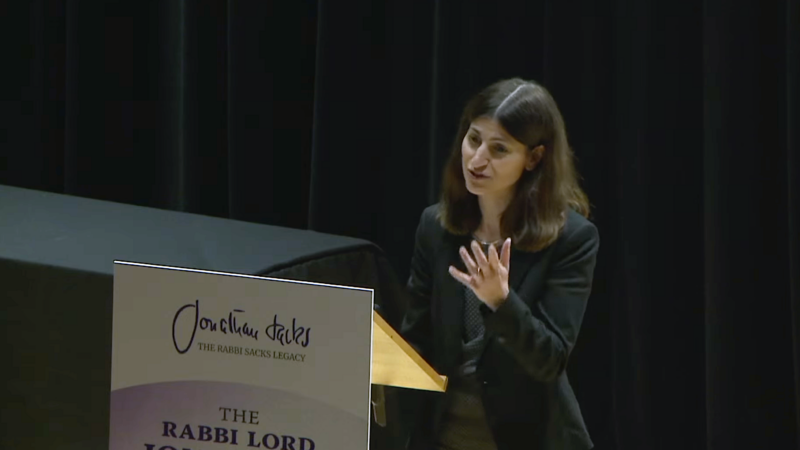
The Rt. Hon. Gordon Brown served as Prime Minister of the United Kingdom from 2007 to 2010, Chancellor of the Exchequer from 1997 to 2007 and as a Member of Parliament in his home county of Fife, Scotland, from 1983 to 2015.
He is the United Nations Special Envoy for Global Education and is a passionate advocate for the rights of children and believes every girl and boy deserves the opportunity of an education, learning and skills for the future. Since September 2021, he also serves as WHO Ambassador for Global Health Financing.
Gordon is Chair of the High-Level Steering Group of Education Cannot Wait, the education in emergencies fund; Chair of the Inquiry on Protecting Children in Conflict; and serves as Chair of the International Commission on Financing Global Education Opportunity.
Gordon is the author of several books including Beyond the Crash: Overcoming the First Crisis of Globalisation, My Life, Our Times, Seven Ways to Change the World and most recently, Permacrisis: A Plan to Fix a Fractured World.
Paying tribute to Rabbi Sacks after his passing, Gordon Brown said: “Rabbi Sacks taught me the importance of civic society, the limits of markets, the indispensability of a public morality. This new century has been shaped by extraordinary upheavals… but at all times, and throughout these crises, Jonathan was a powerful voice, explaining how learning from these events we can come together and change the world for good.”

Introductory remarks
Gordon Brown: Can I first of all thank Stuart for his very kind and very generous introduction and also for the great philanthropic work that he personally does.
But can I just say by way of introduction also, I am not the ideal person to talk about hope, faith, and charity. You all know the ideal person was the person we're honouring this evening. Rabbi Jonathan Sacks.
You know his erudition. You know his eloquence. You know his conviction.
You know the confidence he had in his values that we relied on.
And I, like so many people here, had him as a mentor. Like so many people here, he was also my teacher. Like so many people here, he was also my advisor and counsellor.
And I felt grateful every time I met him.
He enriched every room he entered. He enhanced every occasion where he spoke. He dignified every broadcast and TV and radio interview that he carried out. And you knew you were in the presence of greatness.
And that is why we mourn and still mourn and miss Rabbi Sacks.
And that is why I say to Elaine, to Gila, to Dina, to Josh, to the eight of the ten grandchildren who I'm pleased are here with us this evening, that we will keep alive the memory of Rabbi Sacks and all the work that he did for which we are incredibly grateful.
All of us will have our individual memories of Jonathan.
I first met him three decades ago when he was writing “The Politics of Hope,” when Elaine kindly entertained us to dinner at her home with the children. And then I was so surprised, and actually I was in awe, when he invited me to write the Foreword to the reprint. There are many reprints of “The Politics of Hope,” and I think I spent more time doing that than I spent on the budget that year.
And Sarah will tell you that when we were on our honeymoon, I was spending a lot of time trying to correct the version of the Foreword so I could try to live up to the erudition of Jonathan.
There's this famous interview he had with Bob Geldof when Bob Geldof at one point said to Rabbi Sacks, “It's time for sacred anger.” I think, actually, with Bob, it was time for sacred expletive anger.
And Jonathan coolly said, “You do the anger, I'll do the sacred.”
And then when it came to the financial crisis, I relied on him so much, because I understood as he understood that this was not simply a financial crisis.
This was a moral crisis.
Bankers had awarded themselves bonuses they didn't deserve, taking risks that they didn't understand.
People were buying goods they didn't need with money they didn't have for a happiness that proved elusive.
And we had to try to understand the moral basis before we could begin to solve the financial crisis.
Jonathan said to me one day, “I have one piece of advice for you.”
And I thought, is he going to tell me to read the Jewish philosophers that I haven't read? Is there something about his notion of rights and responsibilities I haven't understood? Have I not got the point he's making about the covenant of hope?
And he said, “I have one point to make to you. Humour.” He said, “Your speeches need humour.”
He said, “You've got to tell stories. You've got to illustrate the points.”
And right enough, last week, as I was preparing for this talk, I looked up Chat GPT, Jonathan Sacks, humour.
And immediately, ten jokes. And then I said, any more? Another ten. And then I said, any more? Another ten.
And you knew that he brought great humour to the occasion.
And you'll be able to judge this evening whether the pupil that's me has learnt from the teacher in delivering a speech.
Now, I must start with a very sombre note.
Nobody should feel unsafe in this country. Nobody should feel afraid to be in the streets of this country. This should be a safe haven for people.
And there should be no hiding place for those who practise anti-Semitism, no hiding place for those who practise Islamophobia, no hiding place for those who practise and want to preach the policies, the politics of violent extremism.
I want to say that in all the things I do - and I'm a committed but small donor to the Community Security Trust - that we should do everything in our power so that people feel safe in our country, so that we have education and, if necessary, legislation, we have social and cultural interaction, so that we can be part of one community where people feel at home and don't feel at risk of intimidation, don't feel at risk of persecution, don't feel at risk of discrimination.
And I just want to add one thing about the terrible events around the world at the moment.
I feel for all those whose families lost loved ones on October 7th. I feel for those who have families with hostages that are still to be returned. I feel for all those children and women who are suffering at the moment in Gaza and elsewhere. And I do want to say this, that when I was in government in 2008 and 2009, working with the King of Saudi Arabia and the Prime Minister of Israel, working with other people, we could see the way that the problems that existed could in future be solved.
There is a way forward, and I believe it is still possible, and we mustn't - and this is where I want to start talking - we must never lose hope. Because hope is the starting point of everything that Jonathan Sacks wrote about. In “The Politics of Hope,” he says that in a good society, people will have, every member of that - and it's on the poster outside - will have equal access to hope.
That, he says, is what I believe. That, he said, is why I'm writing this.
Now, hope is such an interesting concept.
You experience joy, pleasure, sorrow, pain, but hope is somehow different. It's about anticipation, it's about the future, it's about possibilities. You can be appetitive, you can be aggressive, you can be cooperative, you can be, in so many different ways, compassionate and everything else, but hope, somehow, is a bit different.
It's about, if you're hopeful, it's about looking for progress, it's looking for something to move forward. And you can have all the virtues of patience and humility, all the virtues of kindness, and so on, but hope seems to be hopeful and hopefulness seems somehow a bit different. It's about wanting to change things, and change things for the better.
And if you think about Britain today, when we need hope, perhaps the most dominant mood in our country today, and it's in all the surveys, and there's one by Focal Data published today, pessimism.
More people are pessimistic about the future today than they are optimistic. More pessimistic about their prospects and about the country's prospects than they are optimistic about them.
And if we compare Britain on the pessimism and optimism index that people have created, we are today more pessimistic than people in America, or Germany, or Sweden, or Switzerland, and on a par with people in France and Italy. And it's not just pessimism. It's that people feel the country is moving in the wrong direction. It's that people feel that nothing is going to come right. It's people that feel that something has got to change. And there's one more insidious part of that, is that people are starting to feel this is a zero-sum society.
People are starting to feel that if I win, someone else has got to lose. There's zero growth, and therefore if someone does better, it's going to be at my expense.
Countries are in competition with each other. If one country does better, it's going to be at the cost of our country doing worse.
And it creates a sort of doom loop, because the more pessimistic people become, the more they blame others, and the more they blame others, the more pessimistic they become.
And so hope is more than optimism.
It's more than saying something can be done. It's more than wishful thinking. It's more than saying something might be done. It's more than the wing and a prayer that people talk about, that something could be done. It's more than longing that something should be done.
Hope is actually that something can, should, and must be done.
And that is what it means, I think, to Jonathan in his writings, when he talks about hope. It is not just an anticipation or an expectation. It's an intention of people to do something to change things, and it becomes a moral obligation.
And so hope is so important to our community and where it sees itself in the future.
But Jonathan would say himself that hope was grounded in his faith. And Jonathan made the case for faith being important to the public square.
Now, some people say religion has no place in the public square. It's caused violence. It's caused wars. It's caused conflict. It's caused all sorts of things. Organised religion has actually been one of the sources of some of the greatest problems of mankind.
And, no, Jonathan made the case, and I want to make the case, for people of faith engaging in the public square. Now, Jonathan was not sanctimonious, and the humour that he showed, not just about himself but about religion and about other things, showed it. People worship together, meet together. People go through sorrow together. But it's something more, he said.
Faith is a motivational force.
It makes people do things because of the inspiration they have to serve the community. And we should not underestimate, if we lose the motivational force that is provided by people of faith, then we lose so much which is important to our society. Now, Jonathan believed that passionately, and I agreed with him.
And when he wrote, he was writing to try to influence the public square as well as people of religious faith.
But he also did something that I think he should be remembered for with reverence.
He looked for common ground all the time.
In “The Dignity of Difference” and other books, he's not only finding the common ground between the different denominations, do as you would be done by the Christian religion, what is hateful to you, do not do to your fellow, Judaism. Islam, anybody who truly believes, says Islam, you wish for your brother what you wish for yourself.
And it goes through all the religions, a golden rule of obligation that we accept as part of our faith. But there's common ground too with secular ethics as well, and that's what Jonathan writes about in his book, “Morality.”
Altruism, compassion, reciprocity, all these values are central to just about every moral code that you can think about, whether it also includes honour and humility and other things.
Altruism, compassion and reciprocity are so important. We don't just cooperate out of need, we have a human need to cooperate, and that's what we're saying in these moral codes. And if anybody is in any doubt again about the importance of moral thinking to the politics and the development of our country, think back to 1945 and 1946. The world at absolute zero, a war that had destroyed so much, people camping out in the ruins of a world that had produced not only millions of deaths in war, but the Holocaust, which we found about gradually over that period of time.
And Jonathan did not oppose those secular ethics, people who proposed that. He opposed the moral relativists, he opposed the libertarians, he opposed the existentialists. And I think everybody knows who looks at the history of this country and looks at the history of other countries, all the great social movements, whether it's the abolition of slavery or whether it could be “Drop the Debt,” “Make Poverty History,” campaigns on the environment right up to present day, all of them are built on the strongest ethical foundations.
So hope and faith, and what does that mean for how our society is organised? And when I talk about charity, I'm not just meaning the great work of charities like Jewish Care and others that I know do so well, I'm talking about the original meaning of charity, caritas, a caring society, and I'm talking about tzedakah, the Hebrew word for charity, which means an obligation, a moral obligation to create a better society.
And I think Jonathan had three principles that he would like us to follow, and I want to mention them this evening. First, think of society as a common home, which we build together, a common home we build together.
And he compares that to a hotel. If you think of Britain as a hotel, where you just come and go, where there's no obligation to anybody, that is not going to make a country work. If you think of it like a country home, where someone's in control and the rest are guests and effectively second-class citizens, that won't work.
No, think of society as a common home that we build together, where each of us has rights and each of us has responsibilities. And I think that's the first principle that he lays down that we need to follow.
And the second is, think of Britain and society not just as a contract, because that's too legalistic.
That's thinking of our interests. It's thinking of what we can get or what we can guarantee.
Think of society in terms of a covenant.
Think of society as a covenant built on values, values that we share in common, values that, in the Greek words, ethos and telos, a set of shared beliefs and a set of shared objectives.
And you come to equal access to hope, which is what Jonathan starts his book on hope, talking about. And what does equal access to hope mean?
It probably means equal opportunities for all, unfair privileges for no one. It probably means equality of opportunity, fairness of outcome. It may mean, as John Rawls had put it, consistent with the liberties of all, that inequalities that exist should always be in the interests of the least fortunate. It could be a platform, like Neil Kinnock used to talk about, a platform on which we can build is one where everybody has the chance to realise their very big potential to the full.
And so ethos and telos built on a covenant of hope.
And I think the third principle that he lays down is this partnership. And that means, as he said when he stood in Downing Street one day and he was giving a speech, look, around us are all the institutions of government and that's one part of society.
And then look to the city and you look at all the institutions of finance and these are the institutions of the marketplace.
But think of what lies between, the space between, and that is the centre of everything that really makes life take.
It is individuals, it is families, it is communities, it is churches, it is mosques, it is synagogues, it is community centres, it is schools, it is hospitals.
It is where the energy that comes that makes our society work when the state may seem impersonal and the market may seem beyond our control.
And so Jonathan talks about a partnership where state, market and communities work together, where the whole is bound to be greater than the sum of the parts, where instead of working in isolation, each can work together and we can achieve far more.
And that's what I want to say in my concluding remarks.
What sort of partnership, based on rights and responsibilities, and based on equality of opportunity and fairness of outcome, is the kind of partnership that could bring in a new age of hope?
But I want to apply Jonathan's principles in my final points to the most socially divisive issue in our country today, and that is poverty.
I am seeing in the area I live poverty I never thought I would ever see again in my lifetime.
I'm seeing families that are having to choose between eating and keeping clean. I'm seeing mothers who are ashamed and humiliated because they can't provide for their children the things other children have and their children blame for them not having at all. And I'm seeing people queuing up at the local food banks, having done a full week's work and unable to make ends meet because 70% of children in poverty today are not in poverty because their family has someone unemployed and someone who's in work on low pay.
And tonight there are 140,000 children who will be homeless. 140,000.
There are 400,000 children, from the surveys that have been done, that will sleep on the floor.
There are 800,000 children in this country who now depend on what is going to come out of that food bank this week or next week.
There are a million children who are classified by the Rowntree Trust as destitute because they don't have one of these basic things, shelter or food or clothing or hygiene goods.
And there are three million children who are missing meals because they simply don't have enough food in the home.
There are four changes in social security that have made that happen.
One is that benefits are now a lower proportion of earnings than at any time since these modern records began.
Secondly, child benefits are being cut, including the two-child rule.
Thirdly, you've got a cap being put on housing benefits so that people have to take money out of their food budget to pay for their rent even when they've got little money and should be rent-free.
And fourthly, you've got deductions taking place because when people move on to this new benefit Universal Credit, they get no payment for five weeks and are offered a loan which means that they're continuously paying back that loan.
So the DWP is the biggest debt collector in the country and half the families with children in this country are seeing deductions of 25, in some cases 30%, a week from their benefits, making them impoverished, but automatically because they are paying back loans for a system that really was inequitable in the first place.
And charities are struggling. Charities themselves are finding it difficult because people who have a little, who've given a little, have got nothing more to give to people who have nothing. Charities, in some cases, are having to make up their minds about whether they're going to give up on helping the hungry so they can concentrate on the starving, give up on helping the badly housed so that they can concentrate on the homeless, give up on helping the down and healed because they've got to concentrate on the down and out.
This is not the Britain we want to live in.
This is not the Britain that gives equal access to hope.
This is not the Britain we can be proud of as we talk to people in the rest of the world.
And I say none of us can be happy when there are so many people unhappy.
None of us can be comfortable when there are so many people living without comfort.
None of us can be contented when there is so much discontent.
None of us can be at ease when there are so many millions ill at ease.
And it is not anti-wealth to say that those people who have done well and are wealthy should do a little more to help those who are not so wealthy.
It's not anti-enterprise to say that those people who have done well by being enterprising should do more to help those who haven't had the chance to be enterprising.
It's not anti-business to say that businesses should do more to help people in the communities in which they reside and for which they make their earnings.
And Jonathan said, as you saw in the video only a few minutes ago, “We are stronger when we care for the weak. We are richer when we care for the poor. We are invulnerable when we care for the vulnerable.”
And so what should we do about this? I think there are two major changes that we've got to consider in this partnership against poverty.
The first is we should say clearly as a society that we are aiming to end hunger, to end destitution and to end extreme poverty.
Other countries have constitutions that lay down social rights and require action to be taken. We have no constitution but we don't even have a statement from the people in power that this is the aim, this is necessary for a civilised society, this is necessary for equal access to hope.
And I think, and I say this in conclusion, we are at a turning point.
I think we're at a turning point. We can either become more pessimistic or we can find ways of building hope for the future. We can either see decline or we can see progress by people coming together. We can either see a divided country or we can see a more united country.
And you know that famous poem, Robert Frost, “The Road Not Taken”:
“...Two roads diverged in a wood, and I—
I took the one less travelled by,
And that has made all the difference.”
And you know that Robert Frost wrote that poem when he was in Britain.
It was during the beginning of the First World War. And he was walking the country roads of Britain and therefore it's about walking in the countryside. And his great friend was Edward Thomas, who was a famous poet in Britain at the time as well.
And Edward Thomas walked and did these walks and he had a reputation for being indecisive. And that seems to have been the inspiration, the poem that Robert Frost wrote. And Thomas reads the poem and he decides that he has to become more decisive.
And he decides to sign up for the army. He goes to France and he's dead within a few months.
And Robert Frost had always said that this poem, you could have taken any road and so on and so forth, it wasn't supposed to be a moral poem.
But how could you say it after someone like Edward Thomas had made up his mind that there was destiny calling? And on the basis of reading that poem, he chose to do something very noble on behalf of the country and then paid the absolute price.
And so there are turning points and there is destiny calling and there is something that we can all do together.
And I would like to take out of the memory of Jonathan Sacks that we have a new age of hope. That it is based on responsibilities and rights. That it is based on getting people equal access to hope.
And it is, of course, based on what he did in his groundbreaking work to just how we can partner together in making for a better society. Recognising the sheer power of social conscience and what it can achieve.
Yes, poverty has shaken our country to the core. But our commitment to help those in need should be unshakeable.
Yes, hearts are being broken all the time as a result of destitution. But we have got to make a promise that is unbreakable, that we will deal with poverty.
And yes, hope has been destroyed among so many people. But our desire to build a better society and to build a better safety net in particular for the poor should be indestructible.
Let us learn the lesson from Jonathan Sacks.
Let us follow his work. Let his memory continue forever. Let us make a better society in our time.
Thank you.
Gila Sacks:
Thanks Gordon Brown and organisers.
The work of the Legacy Trust is not about keeping my father's memory alive or honouring his legacy. It is about continuing the work that he began. If we find new ways to engage with the ideas he taught us and respond to the challenges he set for us, as we have done this evening, we will each be helping his work to continue.
So thank you all. At a time when the world seems very dark indeed, you have helped us lift our eyes a little. You have reminded us and challenged us not to give in to despair, not to accept the unacceptable things we see all around us, but to have the courage to hope.
And to always see ourselves as having an ability and a responsibility that be a part of the change we hope to see in the world. Rabbi Sacks had huge respect for your leadership and your moral courage and he valued your friendship very dearly. It is a huge honour to his legacy and to that friendship that you gave this evening's inaugural lecture.
So thank you.
The 2026 Annual Memorial Lecture
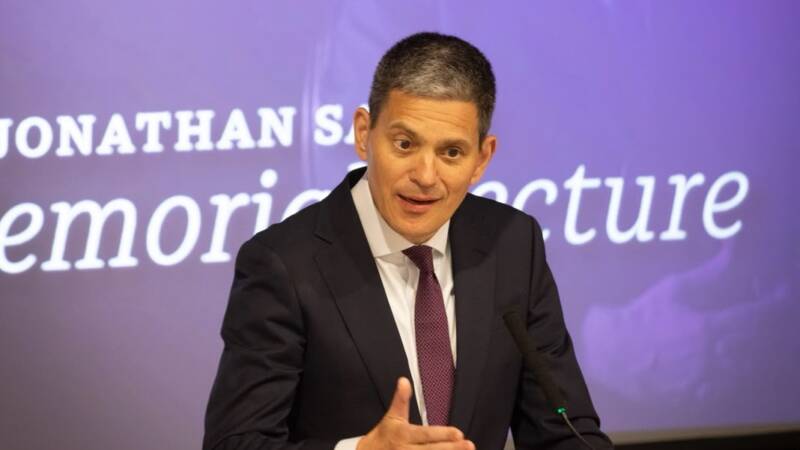
On 9 July 2026, David Miliband gave the third annual keynote speech at The Rabbi Lord Jonathan Sacks Annual Memorial Lecture. The former secretary of state for foreign and commonwealth affairs of the United Kingdom titled his lecture “Kings, Priests and Prophets: Power and its Missing Guardrails” and the event took place at London School of Economics and Political Science.
The 2025 Annual Memorial Lecture
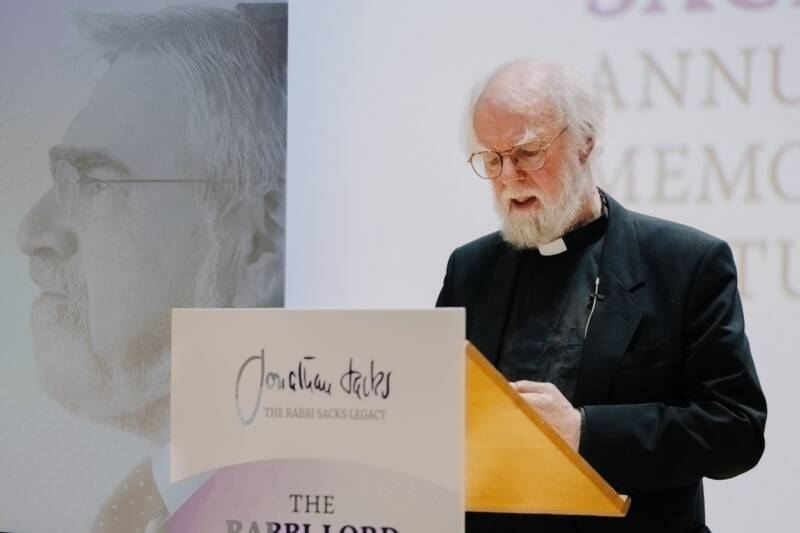
The Rt Revd and Rt Hon Lord Rowan Williams delivered the 2025 lecture on 1 March 2025 at King’s College London.